

Beginner's Guide to Receding Hairline at 20
What a Receding Hairline at 20 Really Means (And What to Do About It)
A receding hairline at 20 is more common than most people think — and if you're noticing yours, you're not alone.
Quick answer: What should you do about a receding hairline at 20?
- Confirm it's actually receding — not just a natural hairline maturation (they look similar but behave very differently)
- Act early — the sooner you address it, the more options you have
- See a specialist — a hair loss professional can identify your Norwood stage and rule out non-genetic causes
- Explore proven solutions — from lifestyle changes to non-surgical options like Scalp Micropigmentation (SMP)
About 25% of men with male pattern baldness begin to notice their hairline pulling back by age 21. For young men in Providence, Cranston, Warwick, and across Rhode Island, that can feel like a gut punch — especially when you're just getting started in life.
The good news? Early intervention makes a real difference.
Not every hairline shift means permanent loss. Some is just your hairline naturally maturing after puberty. But some is the real thing — progressive, hormone-driven recession that won't stop on its own.
Knowing the difference is the first step. Taking action is the second.
This guide walks you through both.
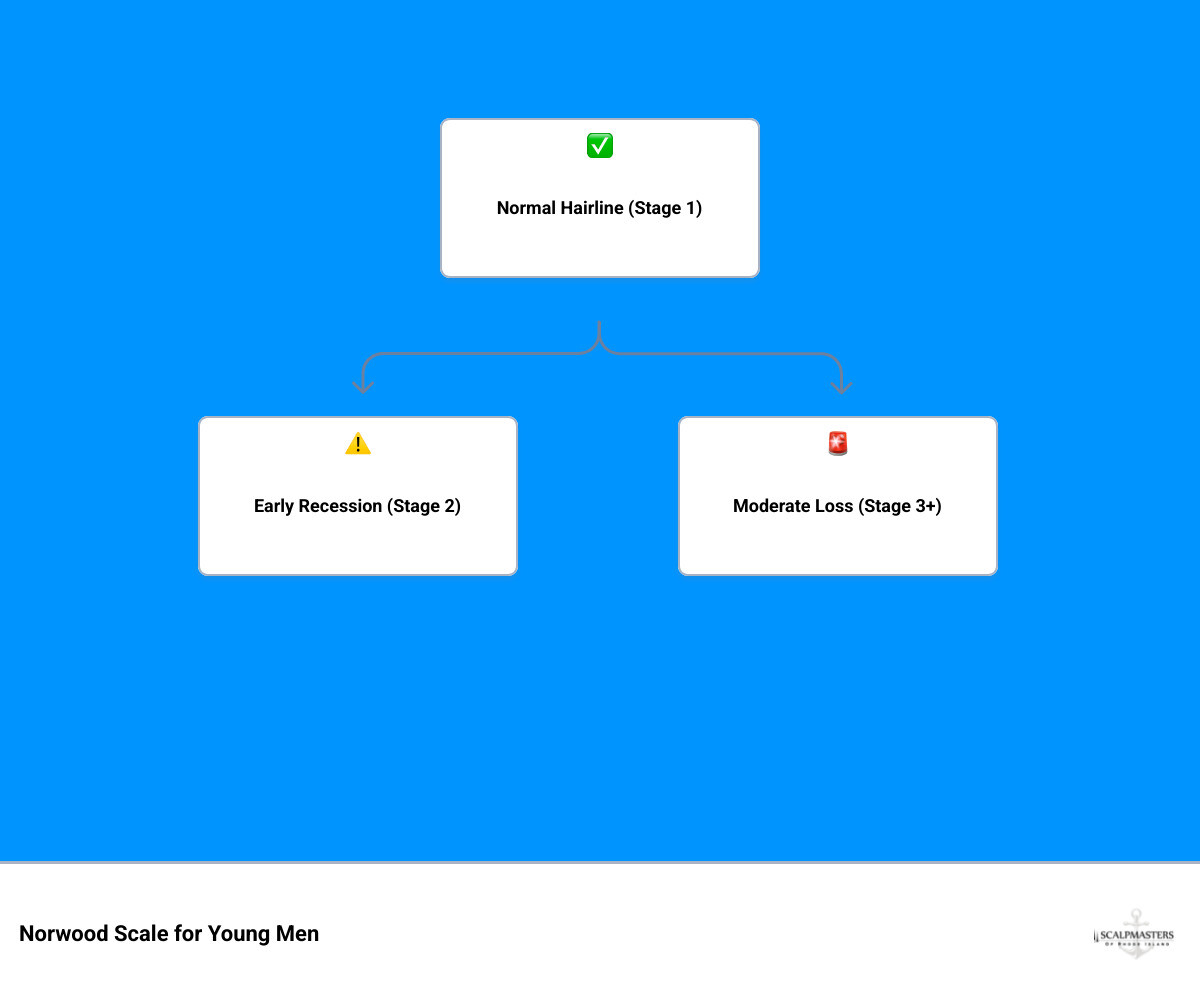
Identifying and Understanding a Receding Hairline at 20
When you’re 20 years old, you’re supposed to be worried about college finals or landing your first job in Providence, not checking the bathroom mirror every five minutes. However, statistics show that 16% of men under 30 already have moderate to severe hair loss.
The process usually begins with miniaturization. This is a scientific way of saying your hair follicles are shrinking. As they get smaller, the hair they produce becomes finer, shorter, and lighter until the follicle eventually stops producing hair altogether. For most guys, this starts at the temples, which is known as Norwood Stage 2.
Signs You Have a Receding Hairline at 20
How do you know if it’s actually happening? Look for these specific indicators:
- The V-Shape or M-Shape: Your hairline starts to retreat at the corners, leaving a more prominent "peak" in the middle.
- Wispy Edges: The hair along your temples starts to look like "baby hair"—thin, translucent, and hard to style.
- Excessive Shedding: While losing 50–100 hairs a day is normal, seeing clumps on your pillow or a carpet of hair in the shower drain is a red flag.
- Scalp Sunburn: If you’re at a PawSox game or hanging out at Narragansett beach and notice your scalp burning where it didn't use to, your hair density is likely dropping.
For a deeper dive into what these changes mean, you can check out these expert insights and proven solutions.
Receding vs. Maturing Hairline: How to Tell the Difference
Not every shift is a crisis. Between the ages of 17 and 29, most men experience a "maturing hairline." This is a natural transition where the juvenile (low and straight) hairline moves up about a finger’s width above the top forehead crease.
| Feature | Maturing Hairline | Receding Hairline at 20 |
|---|---|---|
| Shape | Uniformly higher, relatively straight | Deep V or M-shape at temples |
| Progression | Stops after a small shift | Continues to move back over months |
| Miniaturization | Very little; hair remains thick | Short, thin, "peach fuzz" at the edges |
| Family History | Can happen to anyone | Often linked to male pattern baldness |
A good rule of thumb is the "two-finger" rule: if your hairline has moved more than two fingers' width above your highest forehead wrinkle, it’s likely a receding hairline at 20.
Common Causes of Early Hair Loss in Young Men
Why is this happening now? It usually comes down to a few culprits:
- DHT and Genetics: Dihydrotestosterone (DHT) is a byproduct of testosterone. If you have the "baldness gene" (inherited from either parent, though often linked to the X chromosome from your mother), your follicles are sensitive to DHT, causing them to wither.
- Stress: Whether it’s the pressure of being a student at URI or starting a career in Boston, chronic stress can push hair into a "resting phase" (telogen effluvium), causing temporary but scary thinning.
- Nutritional Deficiencies: Low iron, Vitamin D, or protein can starve your follicles.
- Traction Alopecia: If you’re rocking tight man-buns or hats every day, you might be literally pulling your hairline back.
Understanding these causes is the first step toward how to prevent a receding hairline.
Proven Strategies to Manage Early Hair Loss in Rhode Island
If you’ve confirmed that your hairline is on the move, don't panic. In May 2026, we have more tools than ever to handle this. The key for young men in the New England area is choosing a solution that fits an active lifestyle—whether you’re hitting the gym in Warwick or commuting into Providence.
Why Scalp Micropigmentation is the Preferred Non-Surgical Solution
Many young men look for solutions that fit an active lifestyle without the burden of daily maintenance. While some methods require constant application or carry the risk of side effects, Scalp Micropigmentation (SMP) has become the go-to for guys in their 20s for several reasons:
- Immediate Results: You don't have to wait months to see if a treatment is working.
- Zero Surgery: No scars, no downtime, and a more accessible option compared to invasive surgical procedures.
- Perfect Density: SMP uses specialized pigments to replicate the look of natural hair follicles. It fills in the gaps at the temples and crown, making your hair look thick and full again.
- Non-Invasive: It’s essentially a high-tech follicle tattoo that restores your natural hairline shape.
If you want to see why this is considered the best treatment for a receding hairline, it's all about that instant confidence boost.
Lifestyle Changes to Support Hair Health at 20
While you address the physical hairline, you should also support your body from the inside out.
- Eat for Your Hair: Focus on Rhode Island favorites like fresh seafood (omega-3s), spinach, and eggs. Protein, iron, and zinc are the building blocks of hair.
- Manage Your Stress: Take a walk through Roger Williams Park or try meditation. Lowering cortisol levels can stop stress-related shedding in its tracks.
- Gentle Grooming: Stop scrubbing your scalp like you’re cleaning a kitchen floor. Use sulfate-free shampoos and avoid high-heat blow dryers.
For more tips on keeping things chemical-free, check out our receding hairline natural solution guide.
Professional Solutions: Scalpmasters of RI
At Scalpmasters of RI, we understand that a receding hairline at 20 feels different than it does at 50. You want to look like you again, not like you’re wearing a hairpiece or hiding under a hat.
Based in Cranston, RI , we serve young men from across New England—including Providence, Warwick, Johnston, and Pawtucket. Our founder’s artistry ensures that your new hairline doesn't look like a straight line drawn with a ruler; it looks like the natural, textured hairline you had at 17.
We specialize in:
- Hairline Restoration: Rebuilding those receding temples with precision.
- Density Fills: Making thinning hair look thick and lush again.
- Natural Artistry: Matching your specific hair color and skin tone for a 100% undetectable finish.
SMP is the ultimate "set it and forget it" solution. You can swim, sweat, and live your life without worrying about your hair "moving" or thinning further. For those exploring all their hair loss treatment options, we invite you to see the Scalpmasters difference.
Conclusion: Taking Control of Your Confidence
Noticing a receding hairline at 20 isn't the end of the world, but it is a call to action. Whether you choose to adjust your lifestyle or opt for the permanent, natural look of Scalp Micropigmentation, the most important thing is that you don't let it steal your confidence.
If you’re in the Rhode Island area and want to talk to an expert who has helped hundreds of young men regain their edge, reach out to us at Scalpmasters of RI in Cranston. You’ve got a lot of life ahead of you—make sure you face it with a hairline you’re proud of.
Learn More
What's New
Latest Hair Loss Solutions & Guides