
5 Things Your Hair Loss Clinic Boston Won’t Tell You
What to Know Before Choosing a Hair Loss Clinic in Boston
If you're looking for a hair loss clinic in Boston, you will find a wide range of options serving Greater Boston, Suffolk County, and the broader New England region.
Hair loss is deeply personal. Whether you're noticing a receding hairline, thinning on the crown, or patchy bald spots, the effect on your confidence can be significant.
Boston has no shortage of clinics promising to fix the problem. But not every clinic will give you the full picture before you commit.
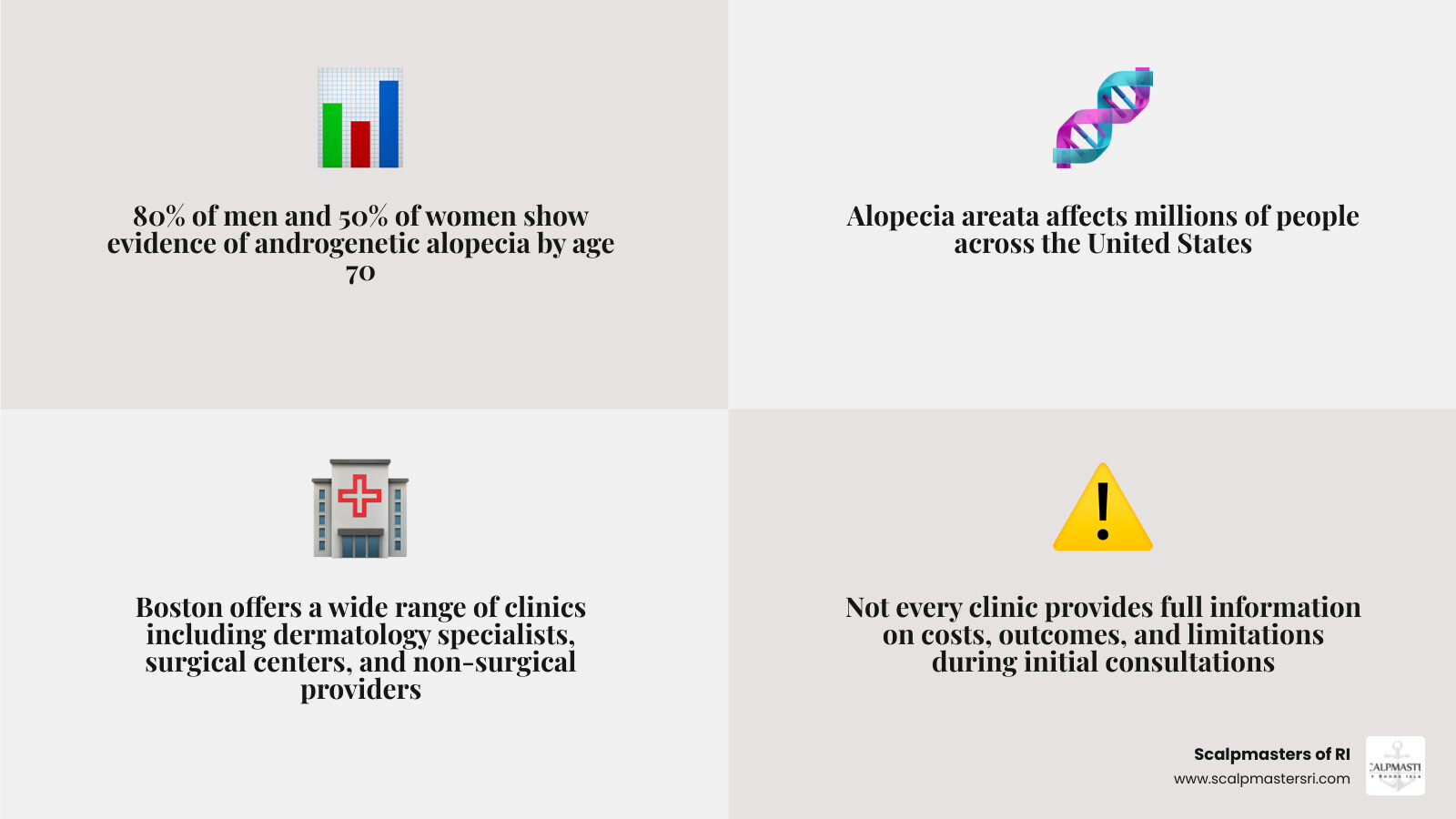
Research shows that 80% of men and 50% of women show evidence of androgenetic alopecia by age 70. Millions more deal with alopecia areata, scarring conditions, and other causes of hair loss. That's a huge number of people navigating a complicated, often expensive treatment landscape.
Here's the thing: the Boston-area hair loss industry includes everyone from surgical transplant specialists to non-surgical providers. The range of options, costs, and outcomes varies enormously. And some critical information rarely comes up during a first consultation.
This guide breaks down five things most hair loss clinics in Boston won't tell you upfront — so you can make a smarter, more confident decision about your hair restoration journey.
5 Hidden Truths About Your Hair Loss Clinic Boston Options
When you walk into a clinical consultation in the Boston MetroWest area, Back Bay, Worcester, or down in Providence, you are often met with high-pressure sales pitches or overly complex medical jargon. While these clinics offer cutting-edge medical science, they also operate as businesses.
Managing patient expectations isn't always their top priority when a high-value surgical package or an expensive, multi-session therapy plan is on the line. To get the results you actually want, you need to look past the glossy brochures and understand the realities of traditional hair restoration.
1. Many Alopecia Diagnoses Do Not Require Invasive, High-Risk Surgical Procedures
When people notice thinning hair, their minds often jump straight to surgical hair transplants. However, many Boston hair loss specialists in areas like Quincy, Newton, and Brookline know that surgical intervention is often unnecessary—and sometimes even counterproductive.
Hair loss is broadly categorized into two types:
- Non-scarring alopecia: The most common form of hair loss (including androgenetic alopecia and alopecia areata), where the hair follicles remain intact and viable under the scalp.
- Scarring alopecia: A rarer, inflammatory condition that causes permanent, irreversible damage to the hair follicles by replacing them with scar tissue.
Because androgenetic alopecia affects 80% of men and 50% of women by age 70, and alopecia areata affects millions of people in the U.S., most cases fall under the non-scarring category. This means your follicles are often just inactive, not gone.
For women experiencing diffuse thinning, surgical transplants are rarely a good fit because there is no stable "donor area" to pull hair from. If you are exploring options, non-invasive approaches like Scalp micropigmentation for alopecia can replicate the look of natural hair density without a single incision. This is especially true when addressing hair loss for women, where non-surgical, cosmetic density solutions deliver far more predictable and satisfying results.
2. The True Cost of Traditional Clinical Procedures Goes Far Beyond the Initial Quote
When a hair loss clinic Boston representative gives you a quote for a hair transplant or a series of Platelet-Rich Plasma (PRP) injections, they are often leaving out a long list of hidden fees.
Surgical hair restoration involves a web of sneaky costs, including:
- Surgical and specialist fees
- Anesthesia fees
- Facility fees for the operating room
- Post-operative medications and specialized shampoos
- Touch-up surgeries when the first graft doesn't take fully
Because hair loss treatments are almost universally classified as cosmetic, health insurance coverage is virtually non-existent. To make these procedures seem affordable, clinics in Back Bay, Boston MetroWest, and Worcester will heavily promote third-party financing options like PatientFi or Advance Care. While these services help break up the payments, they can trap you in high-interest payment plans for years.
To put this in perspective, let's look at how the lifetime costs of traditional clinical treatments compare to non-surgical alternatives:
| Treatment Type | Upfront Cost | Ongoing Maintenance Costs | Hidden/Associated Fees | Lifetime Cost Expectation |
|---|---|---|---|---|
| Surgical Transplant (FUE/FUT) | High | Low to Moderate (meds) | Anesthesia, facility fees, touch-up surgeries | Extremely High |
| Clinical PRP Therapy | Moderate | High (requires 3-4 sessions/year) | Consultation fees, recovery products | High (recurrent) |
| Scalp Micropigmentation (SMP) | Moderate | Extremely Low (minor touch-up in 5-7 years) | None | Low & Predictable |
If you want a breakdown of how non-surgical options compare financially, check out our ultimate scalp micropigmentation cost guide.
3. Traditional Clinical Treatments Often Fail to Deliver Guaranteed, Permanent Results
Perhaps the best-kept secret of clinical hair therapies in Cambridge, Brookline, Somerville, and Waltham is the lack of long-term guarantees.
Medical treatments like PRP therapy use your body’s own blood plasma to stimulate inactive follicles. While the science is fascinating, the clinical outcomes are highly unpredictable. Some patients see mild improvement, while others see absolutely no change after spending thousands of dollars.
Even surgical transplants do not guarantee a lifetime of thick hair. A transplant simply moves hair from the back of your head to the front. It does not stop the underlying biological process of pattern baldness. Over time, the non-transplanted hair around your new hairline will continue to thin, leaving you with awkward, patchy patterns unless you undergo secondary surgeries.
4. Surgical Hair Restoration Leaves Permanent Scarring and Has Major Limitations
Surgical clinics love to market Follicular Unit Excision (FUE) as a "scarless" procedure. This is simply not true.
While FUE does not leave the long, linear scar associated with Follicular Unit Transplantation (FUT/strip surgery), it still leaves hundreds of tiny, circular white scars across the donor site on the back of your scalp. If you ever decide to shave your head or wear your hair short, these scars will be highly visible.
Furthermore, surgical hair restoration is bound by strict physical limitations:
- Donor Site Depletion: You only have a limited amount of healthy donor hair. If your hair loss is advanced, you simply won't have enough donor grafts to cover the bald areas.
- Graft Survival Limitations: Not every transplanted hair follicle survives the relocation process.
- Recovery Timeline: Post-surgical recovery requires weeks of swelling, discomfort, and avoiding physical activity, with final results taking up to a year to fully manifest.
For patients in Downtown Boston, the South End, or nearby Cranston, it is vital to weigh these surgical realities. Before making a decision, consider reading our guide comparing scalp micropigmentation to hair transplants to see which path aligns best with your lifestyle and expectations.
5. The Hidden Drawbacks and Lifetime Costs of Temporary Chemical Treatments
If you want to avoid surgery, a hair loss clinic Boston will likely prescribe daily oral or topical chemical treatments like minoxidil, finasteride, or spironolactone. What they won't emphasize is that these are lifetime commitments with potential side effects.
The daily routine of applying topical solutions can lead to chronic scalp irritation, itching, and greasy hair. Oral medications carry risk profiles that many patients find uncomfortable, including hormonal imbalances, brain fog, and fatigue.
More importantly, these chemical treatments only work for as long as you use them. The moment you stop taking the medication or applying the topical solution, any hair you managed to keep or regrow will shed rapidly. For residents in Providence, Rhode Island, and Quincy, this means signing up for a lifetime subscription of monthly pharmaceutical bills just to maintain a temporary result.
If you're a man dealing with a receding hairline and want to explore the reality of these options, check out our article exploring hair loss treatments for men.
6. Scalp Micropigmentation Offers an Immediate, Guaranteed, and Maintenance-Free Alternative
If the high costs, unpredictable results, surgical scarring, and lifetime chemical dependencies of traditional clinics sound exhausting, there is a better way. Scalp Micropigmentation (SMP) is a modern, non-surgical solution that delivers guaranteed, immediate results.
SMP is the process of using specialized, medical-grade pigments to deposit thousands of micro-dots into the outer layer of the scalp. This duplicates the exact look of natural hair follicles.
- For thinning hair: It adds crucial density, making the scalp invisible underneath your natural hair.
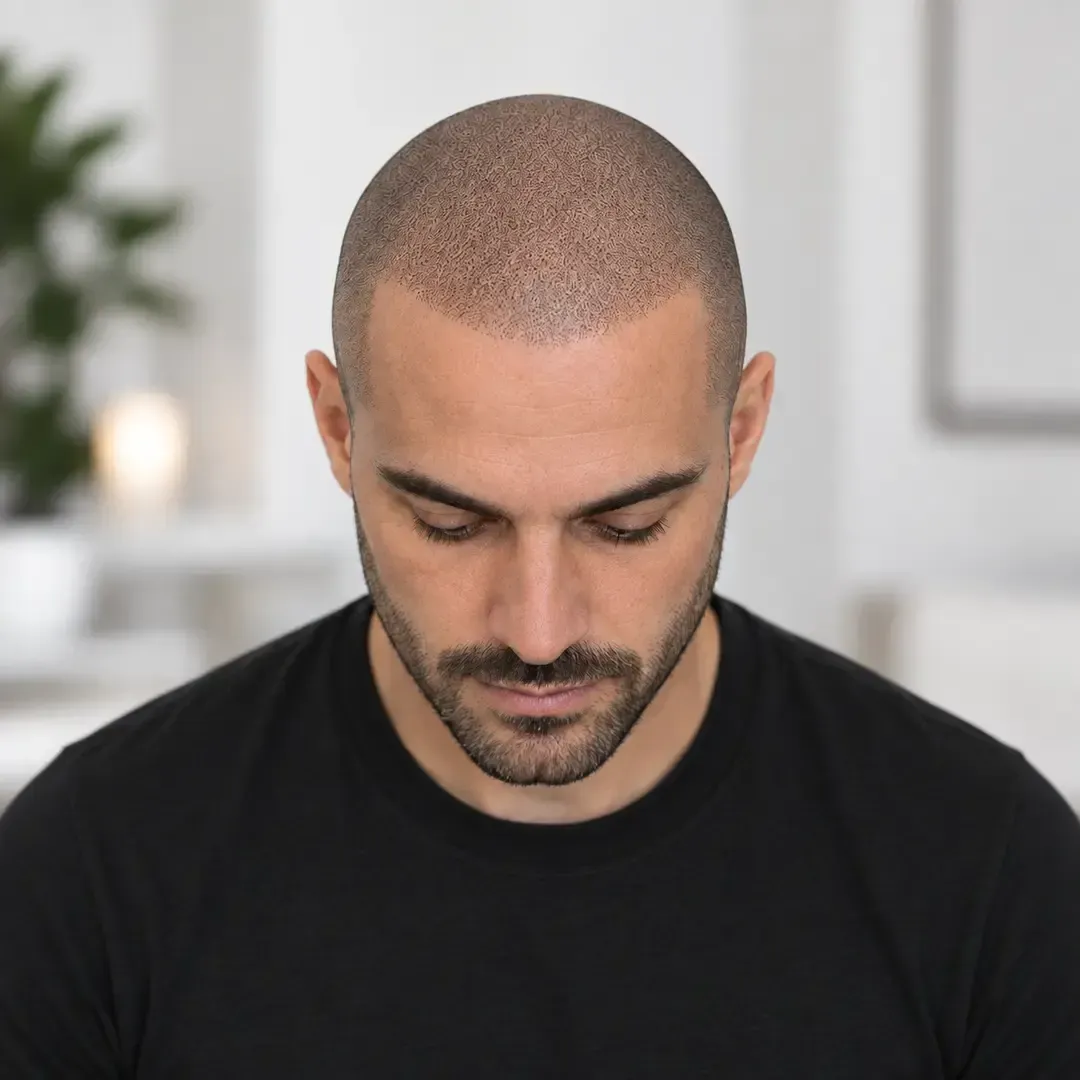
- For receding hairlines or baldness: It creates the clean, youthful look of a freshly shaved head or a buzz cut.
Whether you are in Cranston, RI, Boston, MA, or anywhere in New England, SMP offers an immediate confidence boost without the downtime, surgical risks, or monthly medication bills. To understand the science and artistry behind this technique, read about what is SMP and browse through our scalp micropigmentation before and after guide to see the realistic, natural-looking results we achieve.
Conclusion: Making the Right Choice for Your Hair Restoration Journey
Navigating your options at a hair loss clinic Boston can feel overwhelming, but you don't have to sign up for invasive surgeries or lifetime chemical routines to get your confidence back.
At Scalpmasters of RI, located in Cranston, Rhode Island, we provide a warm, honest, and highly personalized approach to hair restoration. Serving clients across Greater Boston and New England, we specialize in delivering precise, natural-looking scalp micropigmentation treatments tailored to your unique hair pattern and goals.
We believe in upfront honesty, zero hidden fees, and results that you can see instantly. Ready to take control of your hair restoration journey? Schedule a consultation for scalp micropigmentation in Boston MA with us today, and let us help you restore your hairline and your confidence.
Learn More
What's New
Latest Hair Loss Solutions & Guides