

Fix Your Balding Hairline Without Losing Your Mind
What Are the Best Treatments for a Receding Hairline?
The most effective treatments for receding hairline progression depend on your stage of hair loss, but here are the main options ranked from least to most invasive:
- Finasteride (oral)- Blocks DHT, stops loss in ~85% of men
- Minoxidil (topical or oral)- Stimulates growth, works in ~40% of users
- Combination therapy- Finasteride + minoxidil together; 92.4% of patients stable or improved at 12 months
- Low-Level Laser Therapy (LLLT)- FDA-cleared device therapy to stimulate follicles
- PRP therapy- Platelet-rich plasma injections to reactivate follicles
- Scalp Micropigmentation (SMP)- Non-surgical cosmetic solution; 94% client satisfaction
- Hair transplant surgery (FUE/FUT)- Permanent surgical restoration for advanced loss
If you've ever caught yourself standing in front of a mirror, pushing your hair back, and quietly wondering when exactly this started — you're not alone.
Male pattern baldness affects 65-85% of men by age 35. And a receding hairline is almost always the first sign. It starts subtly: temples that look a little thinner, a forehead that seems slightly taller than it used to be.
The good news? You have more options than ever before. From simple daily medications to non-surgical cosmetic solutions to permanent surgical restoration — there's a real path forward no matter what stage you're at.
The key is understanding which treatment matches your situation — because starting early makes a significant difference. Every month of delay can mean more follicle miniaturization caused by DHT, the hormone at the root of most hairline recession. And some of that damage can become permanent.
This guide walks you through every major treatment option, how they work, what results to expect, and how to find the right fit for your hair loss pattern and goals.
Causes and Stages of Hairline Recession
To fix a problem, we first have to understand why it’s happening. For the vast majority of men in New England and beyond, a receding hairline is caused by androgenetic alopecia, commonly known as male pattern baldness.
The primary villain in this story is a hormone called Dihydrotestosterone (DHT). DHT is a byproduct of testosterone that, in genetically susceptible individuals, binds to receptors in the hair follicles. This causes a process called "miniaturization." Essentially, the DHT shrinks the follicle until the hair produced is so thin and short that it eventually stops breaking through the surface of the skin.
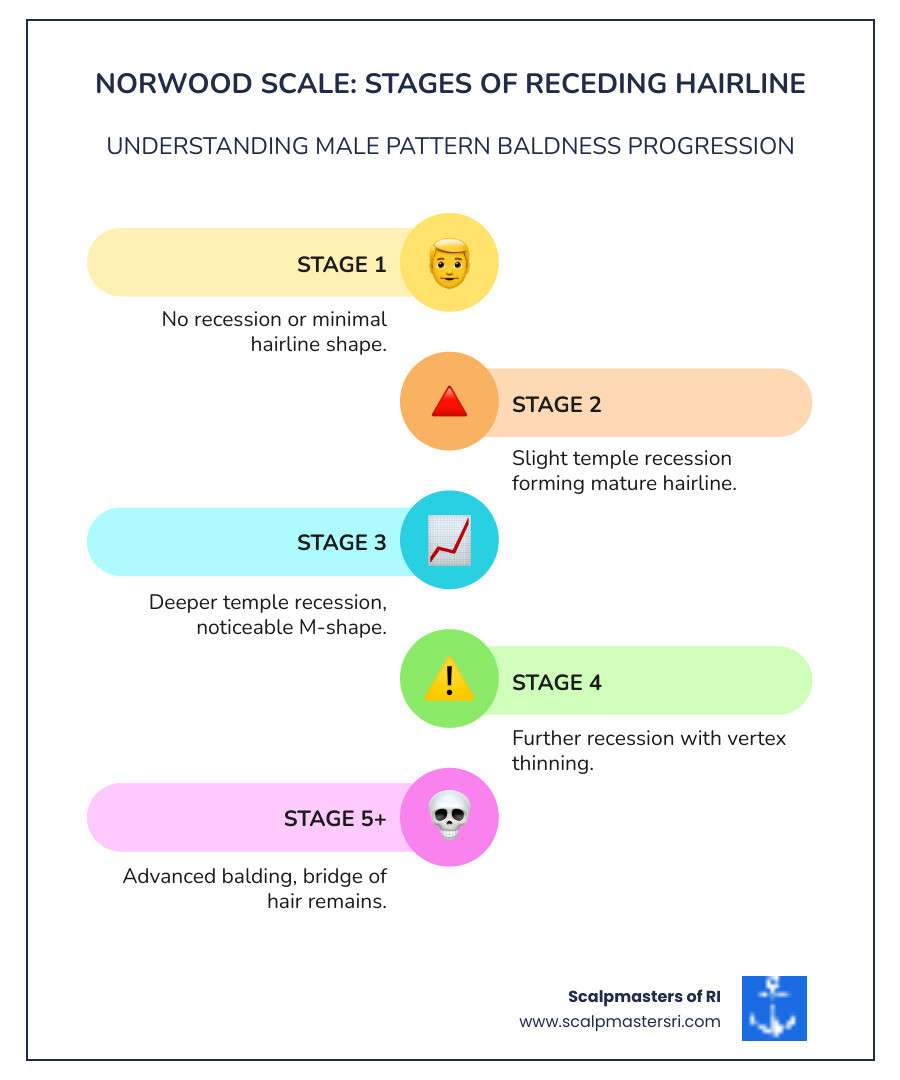
Understanding the Norwood Scale
In hair restoration, we use the Norwood Scale(or Hamilton-Norwood Scale) to classify the stages of recession. It ranges from Stage 1 to Stage 7:
- Stage 1: No significant hair loss or recession.
- Stage 2: Minor recession at the temples (often called a "mature hairline").
- Stage 3: The first stage of "clinically significant" balding. The temples recede deeply, often forming an M, U, or V shape.
- Stage 4: Severe recession at the temples and thinning at the crown (the vertex), but a bridge of hair still separates the two areas.
- Stage 5-7: The bridge of hair disappears, leading to advanced balding where only a "horseshoe" of hair remains around the sides and back.
Identifying where you fall on this scale is crucial because it dictates which treatments for receding hairline will be most effective. For instance, medications work best at Stages 1-3, while surgical options or scalp micropigmentation become more relevant at Stage 4 and beyond. If you've noticed your hairline looking a bit "off," you might wonder: is-an-uneven-hairline-normal? While slight asymmetry is common, a progressive shift backward usually signals the start of androgenetic alopecia. For a deeper dive into these patterns, check out our guide on receding-hairline-in-men-expert-insights-and-proven-solutions or read more about Receding Hairline: Stages, Signs and How to Fix It.
FDA-Approved Medical treatments for receding hairline
When it comes to pharmaceutical treatments for receding hairline, there are two heavy hitters that have stood the test of time and FDA scrutiny: Minoxidil and Finasteride.
Minoxidil (Rogaine)
Originally high blood pressure medication, Minoxidil was found to have a "hairy" side effect. It works as a vasodilator, meaning it widens blood vessels to deliver more oxygen and nutrients to the hair follicles. It also extends the "anagen" or growth phase of the hair cycle.
- Efficacy: Approximately 40% of users see new growth.
- Application: Usually a topical foam or liquid applied twice daily.
Finasteride (Propecia)
This is a 5-alpha-reductase inhibitor. Its job is to block the enzyme that converts testosterone into DHT. By lowering DHT levels in the scalp by about 70%, it stops the miniaturization process in its tracks.
- Efficacy: Stops hair loss in 85% of men and regrows hair in 65% with consistent use.
- Application: A once-daily 1mg oral tablet.
| Feature | Minoxidil | Finasteride |
|---|---|---|
| Type | Topical (OTC) or Oral | Oral (Prescription) |
| Mechanism | Increases blood flow/growth phase | Blocks DHT production |
| Best For | Stimulating new growth | Stopping further loss |
| FDA Approved | Yes | Yes |
Choosing the best-treatment-for-receding-hairline often starts with a consultation to see which of these (or both) fits your medical history. You can find more about these receding-hairline-solutions on our dedicated service pages.
The Efficacy of Combination treatments for receding hairline
If one is good, two is often better. Research consistently shows a synergistic effect when using both medications. A prominent study found that 92.4% of patients using a combination of oral finasteride and topical minoxidil remained stable or showed improvement after 12 months.
By attacking the problem from two angles—blocking the hormone that causes loss and stimulating the follicle to grow—you give your scalp the best possible chance. This is often referred to as a thinning-hairline-treatment protocol. Recently, some dermatologists have also begun prescribing oral minoxidil, which can be more convenient and sometimes more effective for the frontal hairline than the topical version.
Gender-Specific Considerations for treatments for receding hairline
Hair loss isn't just a "guy thing." Women also experience recession, though it often presents differently. While men tend to recede at the temples (the M-shape), women usually experience diffuse thinning across the top or a widening part line, often measured on the Sinclair Scale.
- Women: Finasteride is generally not recommended for pre-menopausal women due to potential birth defect risks. Instead, topical minoxidil (2% or 5%) and Spironolactone (which blocks androgens) are common choices. For more specific advice, see blog/how-to-stop-a-receding-hairline-for-women.
- Transgender Individuals: Gender-affirming hormone therapy can significantly impact hair. Estrogen and anti-androgens often improve hair density in trans women, while testosterone therapy may accelerate androgenetic alopecia in trans men, depending on their genetic predisposition.
Non-Surgical and Surgical Restoration Options
Sometimes, medication isn't enough, or the hair has been gone for so long that the follicles have completely scarred over. In these cases, we look toward restoration.
Platelet-Rich Plasma (PRP) and PRF
PRP involves drawing your own blood, spinning it in a centrifuge to concentrate the platelets, and injecting that "liquid gold" back into your scalp. These platelets are packed with growth factors that can wake up dormant follicles. Platelet-Rich Fibrin (PRF) is a newer, more concentrated version that some studies suggest is even more effective.
Low-Level Laser Therapy (LLLT)
You may have seen "laser caps" or combs. These FDA-cleared devices use medical-grade lasers to deliver red light to the scalp. This light energy is absorbed by the cells (photobiomodulation), stimulating metabolic activity and encouraging the hair to enter the growth phase. It’s a great "set it and forget it" home treatment.
Hair Transplant Surgery: FUE vs. FUT
This is the only way to "move" hair to where it no longer grows.
- FUT (Follicular Unit Transplantation): Also known as the "strip method," where a strip of skin is taken from the back of the head. It's efficient for large areas but leaves a linear scar.
- FUE (Follicular Unit Extraction): Individual follicles are punched out one by one. This is the gold standard for hairline work because it leaves no linear scar and allows for a very natural, "soft" hairline design.
For many in the Rhode Island and Massachusetts area, exploring hair-loss-treatments-exploring-options-for-men-with-receding-hair is the first step toward deciding between these clinical paths. You can also review Hair Loss Treatments: Topical, Medications & Surgery Options for a broader medical perspective.
Scalp Micropigmentation for Immediate Density
If you want the appearance of a full head of hair without surgery or a 6-month wait for meds to kick in, Scalp Micropigmentation (SMP) is a game-changer.
Think of it as a highly specialized, medical-grade cosmetic tattoo. At Scalpmasters of RI, we use micro-needles to deposit pigment into the scalp, replicating the look of individual hair follicles.
- Immediate Results: You walk out of the session with a defined hairline.
- Versatility: It can be used to create a "buzz cut" look for completely bald men or to add "density" to thinning hair so the scalp doesn't peek through.
- High Satisfaction: SMP boasts a 94% client satisfaction rate.
It is an incredible solution for those asking blog/can-hairline-tattoos-correct-receding-hairlines. Whether you are in Cranston, Boston, or anywhere in New England, this artistry can restore the frame of your face instantly.
Lifestyle Changes and Home Remedies
While they might not "cure" genetic balding, lifestyle factors play a massive role in how healthy your hair is and how fast you lose it.
- Scalp Massage: A 2016 study found that just 4 minutes of daily scalp massage can increase hair thickness by stretching the cells of the hair follicles.
- DHT-Lowering Foods: While not a replacement for Finasteride, foods like green tea, turmeric, soy, and pumpkin seeds contain compounds that may help naturally lower DHT.
- Nutrition: Your hair needs building blocks. Ensure you're getting enough Zinc, Biotin, Iron, and Vitamin D. A deficiency in any of these can lead to "telogen effluvium," a type of temporary shedding that makes a receding hairline look much worse.
- Stress Management: High cortisol levels can push hair into the "resting" phase prematurely.
- Gentle Styling: Avoid tight "man buns" or harsh chemical relaxers which can cause traction alopecia. If you're struggling with how to style what you have, check out the-ultimate-guide-to-haircuts-for-men-with-receding-hairlines or styling-tips-to-minimize-the-appearance-of-a-receding-hairline.
For more tips on keeping what you've got, read our post on blog/how-to-prevent-receding-hairline.
Frequently Asked Questions about Receding Hairlines
Can a receding hairline grow back?
The short answer is: Yes, but it depends on the follicle. If a follicle has been dormant for years and the skin is smooth and shiny, it has likely scarred over, and medication won't bring it back. However, if you are in Norwood Stages 1-3 and the follicles are simply "miniaturized" (producing tiny, peach-fuzz hairs), treatments like Finasteride and Minoxidil can absolutely revitalize them.
How long does it take to see results?
Patience is the hardest part of any hair loss journey. Most treatments for receding hairline take 3 to 6 months to show visible results. In fact, many people experience a "dread shed" in the first few weeks of using Minoxidil or Finasteride. This is actually a good sign! It means the old, weak hairs are being pushed out to make room for new, stronger strands.
What are the side effects of medical treatments?
- Minoxidil: Can cause scalp irritation, dryness, or unwanted hair growth if it drips onto your forehead.
- Finasteride: A small percentage of men (usually less than 2%) report sexual side effects like decreased libido. These usually resolve if the medication is stopped.
- Surgery: Potential for minor scarring, swelling, or infection, though modern FUE techniques have made recovery much easier.
Conclusion
Facing a receding hairline can feel like a losing battle, but the "losing" part is optional. Whether you choose the medical route with Finasteride and Minoxidil, the surgical route with a transplant, or the artistic, immediate route with Scalp Micropigmentation, the most important step is to act early.
At Scalpmasters of RI, we’ve seen how restoring a hairline can change a person's entire outlook. Based in Cranston and serving the greater New England area—from Boston to Connecticut—we specialize in creating natural, precise hairlines that look like you never lost a day's worth of growth.
If you're tired of checking the mirror every morning, it might be time for a professional perspective. More info about scalp micropigmentation for thinning hair can help you decide if a non-surgical density boost is the right move for you. Don't let your hairline dictate your confidence—take control of the frame.
Learn More
What's New
Latest Hair Loss Solutions & Guides