

Ultimate Checklist for Thinning Hairline Treatment
Understanding Your Options for a Thinning Hairline
Thinning hairline treatment includes medical options like minoxidil and finasteride, surgical procedures such as hair transplants, and cosmetic solutions like scalp micropigmentation (SMP). Here are the most effective approaches:
| Treatment Type | Best For | Results Timeline |
|---|---|---|
| Minoxidil (Rogaine) | Early-stage thinning | 4-12 months |
| Finasteride (Propecia) | Male pattern baldness | 4-12 months |
| Hair Transplant | Advanced hair loss | 6-12 months |
| Scalp Micropigmentation | All stages, immediate visual improvement | 1-3 sessions |
| Lifestyle Changes | Prevention and support | Ongoing |
If you've noticed your hairline moving back more than 1.5-2 cm from where it used to be, you're not alone. Research shows that approximately 50 million males and 30 million females in the United States are affected by androgenetic alopecia—the medical term for pattern hair loss.
By age 50, more than half of all males experience some type of hair loss. By age 70, that number jumps to nearly 80% of males and 50% of females.
The good news? You have more options than ever before. From FDA-approved medications that can stop hair loss in 70% of men after a year of use, to surgical procedures, to innovative cosmetic solutions that deliver immediate visual results—the path forward depends on understanding what's causing your hair loss and which approach fits your lifestyle.
This guide walks you through every stage of the journey. We'll help you identify whether your hairline is naturally maturing or truly receding, explain the science behind why hair follicles shrink, and break down each treatment option with clear timelines and realistic expectations.
Whether you're just starting to notice changes or you've been dealing with a receding hairline for years, this checklist will help you make informed decisions about your next steps.
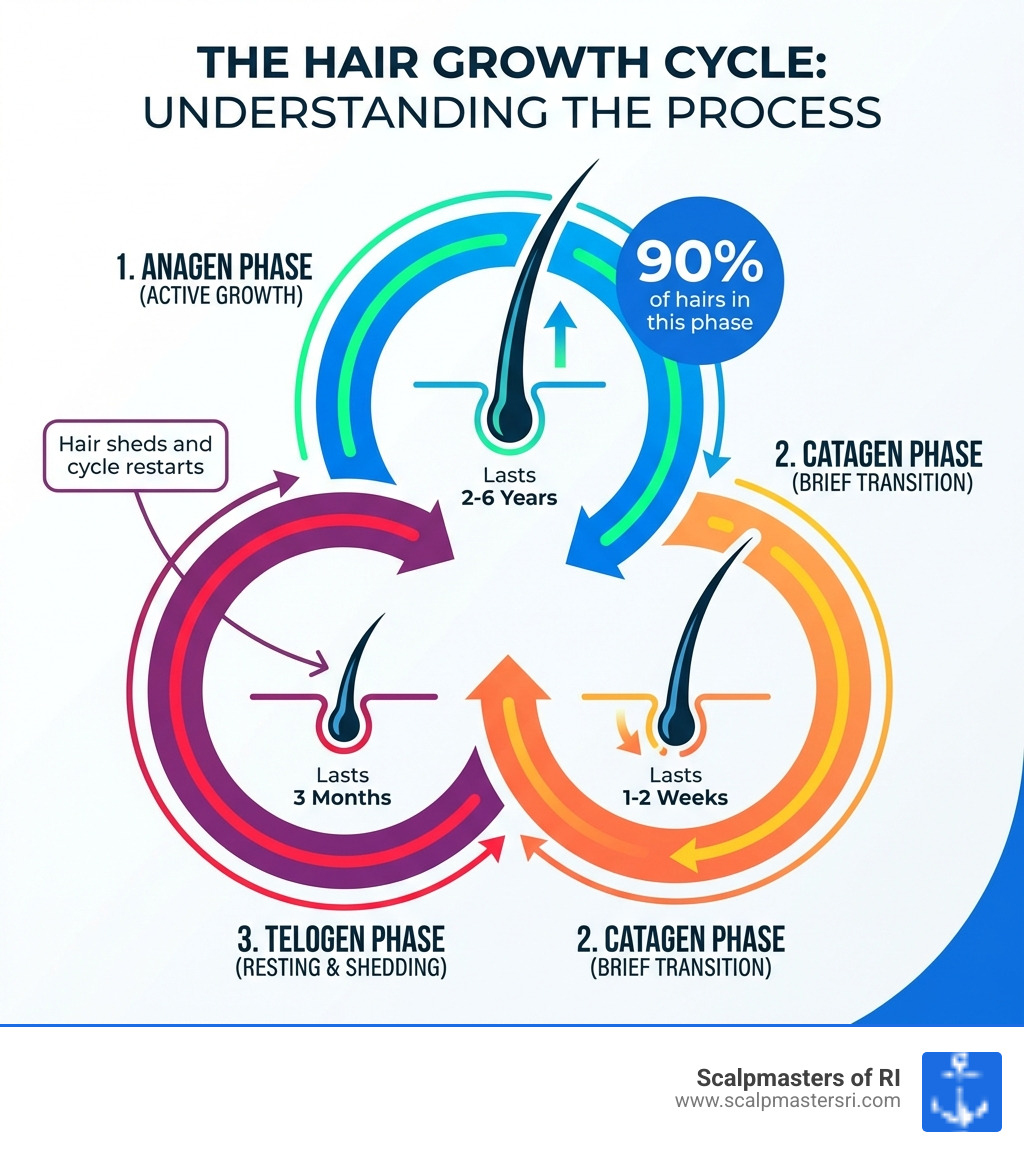
Identifying the Stages and Causes of a Receding Hairline
Understanding the root causes and how a receding hairline progresses is the first step toward effective thinning hairline treatment. The primary causes are a complex interplay of genetics, hormonal changes, and age.
At the heart of male pattern baldness, or androgenetic alopecia, is a hormone called dihydrotestosterone (DHT). If you have a genetic predisposition, your hair follicles can become sensitive to DHT. This sensitivity causes the follicles to shrink, a process known as miniaturization, leading to finer, shorter hairs, and eventually, the cessation of hair growth. This genetic link is strong: males whose fathers are bald could be 5-6 times more likely to lose their hair. If your father is bald, you're twice as likely to have male pattern baldness. And if your maternal grandfather has male pattern baldness, there's a good chance you will too.
Age is another significant factor. Hair loss often increases with age, with more than 50% of males over 50 experiencing some form of hair loss. By age 70, nearly 80% of males and 50% of females are affected. Hormonal shifts that occur naturally as we age can exacerbate this process.
The progression of hairline recession is often categorized using the Norwood Scale, which illustrates stages from minimal recession to extensive baldness. This scale helps us understand the different stages of hairline recession, typically starting with an "M" or "V" shape at the temples and progressing to a more pronounced recession.
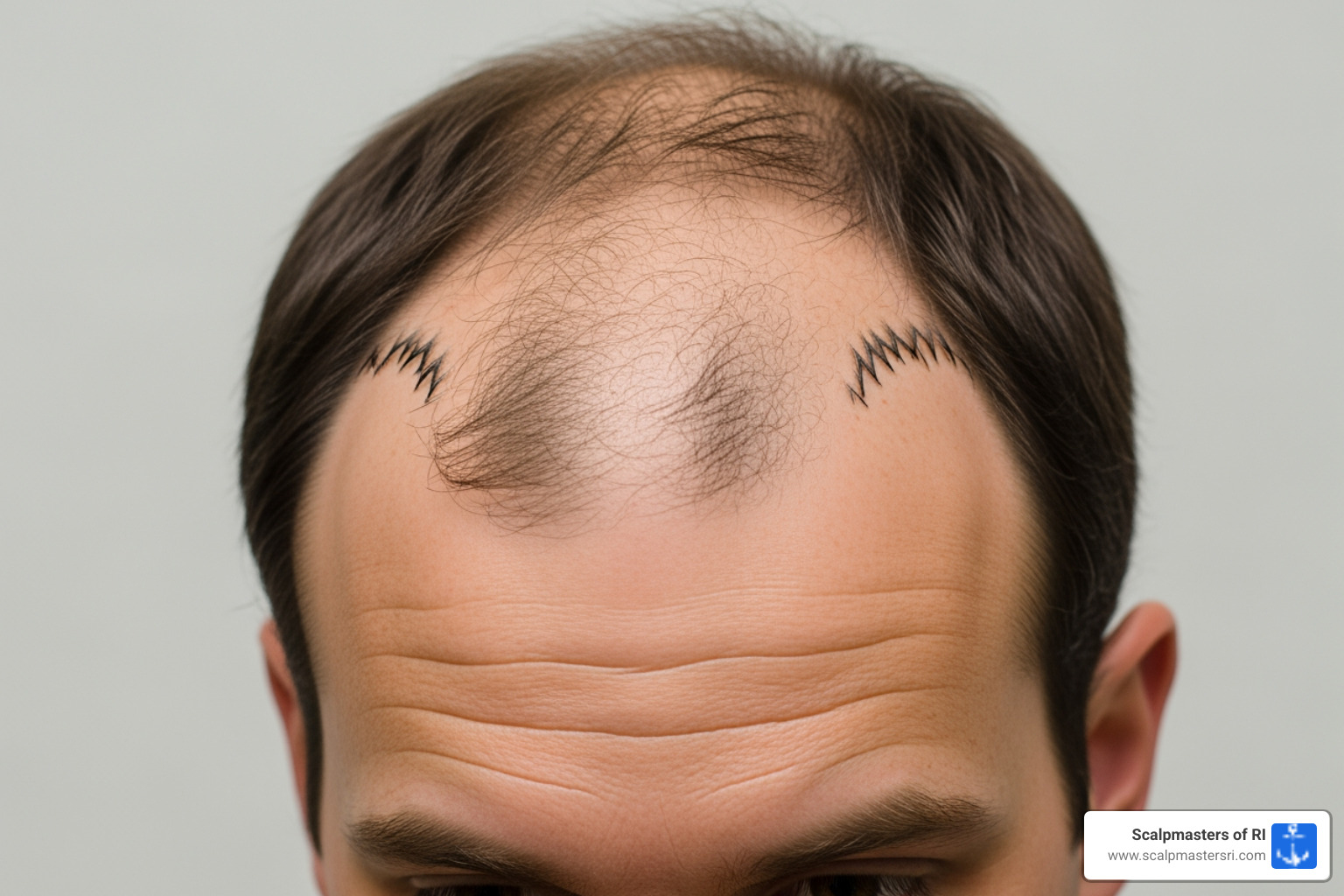
For a detailed visual guide on how to interpret these stages, we recommend consulting a Norwood Scale progression guide. Nearly 50% of males are affected by age 50, making it a very common concern.
Mature Hairline vs. Receding Hairline
It’s crucial to distinguish between a naturally maturing hairline and one that is actively receding. Many people experience a slight adjustment in their hairline as they age, which is entirely normal. This maturation process typically involves the hairline rising by about 1.5 cm to 2 cm above the brow compared to adolescence. It often settles into a slightly higher, but still relatively straight or gently curved, line.
A truly receding hairline, however, goes beyond this natural maturation. It often manifests as a distinct "M-shaped pattern" where the hair at the temples recedes significantly faster than the hair in the center. You might also notice specific areas of hair thinning on the crown or vertex. An uneven hairline or a noticeable widow's peak can also be early indicators. If you're wondering if your hairline is just maturing or actually receding, it's about the degree and speed of the change. A sudden, significant shift or the development of an "M" shape are stronger indicators of recession. For more insights on hairline variations, you can explore whether is an uneven hairline normal?.
Non-Surgical and Cosmetic Thinning Hairline Treatment Options
When considering thinning hairline treatment, many effective non-surgical and cosmetic options are available before resorting to more invasive procedures. These treatments aim to slow hair loss, stimulate new growth, or cosmetically improve the appearance of a fuller hairline.
One of the most common over-the-counter (OTC) medications is minoxidil (Rogaine). This topical solution or foam is designed to improve blood flow to hair follicles, which can stimulate new hair growth and prevent further thinning. While it's widely known as a treatment for overall hair loss, its use for a receding hairline is considered off-label. Research has shown topical minoxidil to work better than a placebo, with a 2015 study finding that it causes new hair growth in approximately 40 percent of people who use it. Minoxidil is available in 2% and 5% concentrations and is applied directly to the scalp, typically twice a day. However, it's important to note that increased shedding can be an initial side effect.
For men, finasteride (Propecia) is a prescription medication that has proven highly effective. It works by lowering the levels of DHT, the hormone primarily responsible for male pattern baldness. Studies show that finasteride can stop frontal balding in 70% of men after a year of use and can even regrow hair on the hairline of 38% of men. Finasteride is taken orally, usually once a day. Potential side effects are rare but can include erectile dysfunction and depression.
Other prescription medications that may be considered off-label include dutasteride (similar to finasteride but more potent), anthralin, and corticosteroids. Corticosteroids are often used for autoimmune-related hair loss conditions like alopecia areata and can be administered as injections, topical creams, or oral medications. Steroid injections can offer an almost 60% improvement in frontal fibrosing alopecia symptoms. Antiandrogens, like spironolactone, are primarily used for female pattern baldness to inhibit hormones that damage hair follicles.
On the cosmetic front, scalp micropigmentation (SMP) offers an immediate and non-invasive solution. SMP is a specialized tattooing technique where tiny, natural-looking pigments are applied to the scalp to replicate the appearance of hair follicles. This creates the illusion of a fuller head of hair, effectively camouflaging thinning areas and restoring a defined hairline. It's an excellent option for those looking for receding hairline solutions without medication or surgery, and we at Scalpmasters of RI specialize in creating natural-looking density improvement. When considering SMP, choosing the right hairline for SMP is a crucial step to ensure the most aesthetically pleasing and natural result for your face shape and age.
Comparing Thinning Hairline Treatment for Men and Women
While the goal of thinning hairline treatment is the same for everyone – to restore or improve the appearance of hair – the approaches often differ significantly between men and women due to biological differences in hair loss patterns and hormonal influences.
In men, androgenetic alopecia typically presents as a receding frontal hairline, often forming the characteristic "M" shape, along with thinning on the crown. Treatments like finasteride, which targets DHT, are highly effective because men's hair follicles are particularly sensitive to this hormone. Minoxidil is also a common choice for men to stimulate growth and slow thinning.
Women, however, more commonly experience diffuse thinning across the top of the head, with a widening of the part, rather than a receding frontal hairline. This is known as female pattern hair loss. While minoxidil is a go-to for women, finasteride is generally not prescribed to premenopausal women due to potential side effects. Instead, antiandrogens like spironolactone might be used to counteract androgen levels if they are contributing to hair loss. Another distinct condition, frontal fibrosing alopecia, which causes scarring and permanent hair loss along the frontal hairline, is more common in postmenopausal women and requires specific treatment approaches, often involving corticosteroids. For women seeking guidance, we have resources on how to stop a receding hairline for women.
Cosmetic solutions like scalp micropigmentation are equally effective for both men and women, providing an immediate visual improvement regardless of the underlying cause or pattern of hair loss.
Timeline for Thinning Hairline Treatment Results
Patience is a virtue when it comes to thinning hairline treatment. It's important to have realistic expectations about when you'll start seeing results, as hair growth is a slow process.
For medications like minoxidil, it typically takes about four months to a year for hair to noticeably thicken. You might even experience an initial "shedding phase" during the first month or two, where some existing hairs fall out to make way for new growth – don't be alarmed, this can be a sign it's working! Consistent application is key. Similarly, finasteride starts to work after about four months, with significant growth potentially taking up to a year. Dermatologists usually assess treatment progress after six months to a year for both minoxidil and finasteride.
Surgical options like hair transplants involve a recovery period, and new hair growth typically begins around 3-4 months post-procedure, with full results visible in 12-18 months.
For cosmetic treatments like scalp micropigmentation, the results are immediate. After 1-3 sessions, your hairline will appear fuller and more defined, offering instant visual improvement. The initial redness subsides quickly, and the density improvement is visible right away.
Regardless of the chosen method, consistency and long-term maintenance are crucial. Most medical treatments require continuous use to maintain results, as stopping them often leads to a recurrence of hair loss.
Advanced Hairline Restoration Solutions
When non-surgical and medical treatments may not be enough, or for those seeking a more permanent or immediate aesthetic solution, advanced hairline restoration options come into play.
Hair transplant surgery, such as Follicular Unit Extraction (FUE) or Follicular Unit Transplantation (FUT), involves taking healthy hair follicles from a donor area (usually the back or sides of the head) and transplanting them to the thinning or balding areas of the hairline. This is a surgical procedure that can provide natural-looking and permanent results, especially for individuals with significant recession. However, it requires a healthy donor supply and a recovery period, with full results appearing over several months as the transplanted hair grows.
Another powerful advanced solution, and one of our specialties at Scalpmasters of RI, is Scalp Micropigmentation (SMP). SMP is a non-surgical cosmetic procedure where skilled practitioners use micro-needles to deposit specialized pigments into the scalp. This creates the appearance of tiny hair follicles, replicating the look of a closely shaven head or adding density to thinning areas. For individuals with a receding hairline, SMP can carefully recreate a natural-looking hairline, providing an immediate and significant aesthetic improvement. It's an excellent option for those who want to avoid surgery, cannot undergo a transplant, or seek to improve existing hair density. We excel in artistic hairline design and density improvement, ensuring natural-looking results that restore confidence. You can learn more about how SMP for thinning hair can transform your appearance.
Natural Remedies and Lifestyle Changes for Hair Health
While medical and advanced treatments offer significant solutions, don't underestimate the power of natural remedies and lifestyle changes as part of a comprehensive thinning hairline treatment strategy. These approaches can support overall hair health, potentially slow down thinning, and complement other treatments.
Diet plays a crucial role. People who do not get enough vitamins and minerals may lose more hair than people who do. Ensuring a diet rich in protein, iron, zinc, and vitamins (especially B vitamins and vitamin D) can support healthy hair growth. For instance, if you're wondering can lack of protein cause hair loss?, the answer is yes, adequate protein intake is vital for hair structure.
Lifestyle factors also have a profound impact. Smoking, for example, is linked to early-onset androgenetic alopecia. It can cause oxidative stress and reduced blood flow to hair follicles, contributing to hair loss. Quitting smoking can significantly benefit your hair health. For more on this, read about the link between nicotine and hair loss. Chronic stress can also trigger hair loss conditions like telogen effluvium, where hair prematurely enters the resting phase and sheds. Practicing stress management techniques such as meditation, yoga, or regular exercise can help.
Gentle hair care is essential. Avoid harsh chemical treatments, excessive heat styling, and tight hairstyles that can cause traction alopecia. Using mild shampoos and conditioners and being gentle when brushing wet hair can minimize breakage and damage.
Some natural remedies have shown promise, though more human research is often needed to confirm their efficacy. Animal studies suggest that peppermint and lavender oils may help promote hair growth. If you're interested in exploring these, we have a guide on how to promote hair growth with essential oils. However, always consult with a healthcare professional before trying new remedies, especially if you are undergoing other treatments.
Frequently Asked Questions about Thinning Hairline Treatment
We often hear many questions from individuals concerned about their thinning hairlines. Here, we address some of the most common inquiries to provide clarity and guidance.
Can a receding hairline grow back on its own?
The answer to whether a receding hairline can grow back on its own largely depends on the underlying cause. If the hair loss is due to temporary factors like severe stress (telogen effluvium), nutritional deficiencies, or certain medications, the hair may regrow once the trigger is removed or addressed. In these cases, the hair follicles are usually still healthy and capable of producing new hair.
However, if the receding hairline is caused by androgenetic alopecia (male or female pattern baldness), which is primarily genetic and hormonal, it is unlikely to grow back on its own. In this condition, the hair follicles shrink over time due to DHT sensitivity, and eventually become dormant. While there is no cure for this type of hair loss, treatments like finasteride and minoxidil may help to increase the number of hairs and slow progression, but they require continuous use. Early intervention is key, as dormant follicles are much harder to reactivate. Without treatment, the recession typically continues.
Are there any side effects to cosmetic hairline treatments?
Cosmetic thinning hairline treatment options, particularly scalp micropigmentation (SMP), are generally safe with minimal side effects when performed by experienced and certified practitioners like us at Scalpmasters of RI.
The most common side effects are temporary and localized:
- Scalp Sensitivity: Some individuals may experience mild redness or tenderness immediately after the procedure, similar to a sunburn. This typically subsides within a day or two.
- Temporary Redness: The treated area might appear slightly red for a few days post-treatment.
- Mild Swelling: Very occasionally, slight swelling may occur, but it's usually minor and resolves quickly.
More serious risks, though extremely rare, can include allergic reactions to the pigments or infection if proper hygiene and aftercare instructions are not followed. This is why thorough consultation requirements, including patch testing for allergies, and strict adherence to post-treatment aftercare are paramount. We ensure all our clients understand the process and how to care for their scalp to maximize results and minimize risks. Unlike surgical options, SMP does not involve incisions, anesthesia, or a lengthy recovery period, making its risk profile significantly lower.
How can I tell if my hairline is actually receding?
Determining if your hairline is truly receding versus naturally maturing is a common concern. Here are several practical methods and signs to help you assess your hairline:
- The "Two Finger" Test: Place two fingers horizontally above your eyebrows. Your hairline should ideally begin around the top of your upper finger. If it's significantly higher than this, it might indicate recession.
- Measure and Track: Take monthly photos of your hairline from the same angle and lighting. You can also measure the distance from a fixed point (like the bridge of your nose or the center of your eyebrows) to your hairline. A consistent increase in this measurement over time is a strong indicator of recession.
- Look for an "M" or "V" Shape: A classic sign of a receding hairline, especially in men, is the development of an "M" or "V" shape, where the hair at the temples recedes more rapidly than the hair in the middle.
- Temple Recession: Pay attention to your temples. If the hair there is noticeably thinning or moving backward, it's a key sign.
- Hair Miniaturization: Examine the hairs along your hairline. Are they becoming finer, shorter, or lighter in color compared to the hair on other parts of your scalp? This miniaturization is a hallmark of androgenetic alopecia.
- Increased Shedding: While normal shedding is 50-100 hairs a day, a significant increase in hair fall, particularly in the frontal area, can be a warning sign.
- Unevenness: If one side of your hairline is receding more than the other, creating an uneven appearance, this could also indicate recession rather than natural maturation.
If you observe these signs, especially if they are progressing, it’s advisable to consult with a specialist. For more detailed insights, you can review expert insights on male hairline recession.
Conclusion
Navigating the landscape of thinning hairline treatment can feel overwhelming, but as we've explored, a wide array of effective options exist. From understanding the underlying causes like genetics and hormones, to identifying the subtle differences between a mature and a receding hairline, knowledge is your first and most powerful tool.
Whether you opt for medical treatments like minoxidil and finasteride, explore advanced surgical solutions such as hair transplants, or choose immediate cosmetic improvements like scalp micropigmentation, the goal is always to find a solution that fits your specific needs and lifestyle. Remember the importance of lifestyle changes and natural remedies in supporting overall hair health, and always consult with professionals to ensure the safest and most effective approach.
At Scalpmasters of RI, based in Cranston, we are dedicated to providing high-quality scalp micropigmentation (SMP) treatments across Rhode Island, Massachusetts (including Boston), and Connecticut. Our expertise lies in crafting natural-looking hairlines and density, using the founder's extensive experience and artistry to deliver precise, confidence-restoring results.
If you're ready to explore how a personalized consultation can help you achieve your desired look, we invite you to connect with us. Reclaim your confidence with an artistic hairline restoration that is custom just for you. Find More info about scalp micropigmentation services and take the next step towards a fuller, more defined hairline.
Learn More
What's New
Latest Hair Loss Solutions & Guides