Scalp Micropigmentation: The Ultimate Ink for Your Injury Scars
Living With a Scalp Scar? Here's What Actually Works
Scalp scar cover up is something thousands of people search for every year — and for good reason. Whether your scar came from a hair transplant, an accident, or surgery, it can feel impossible to hide.
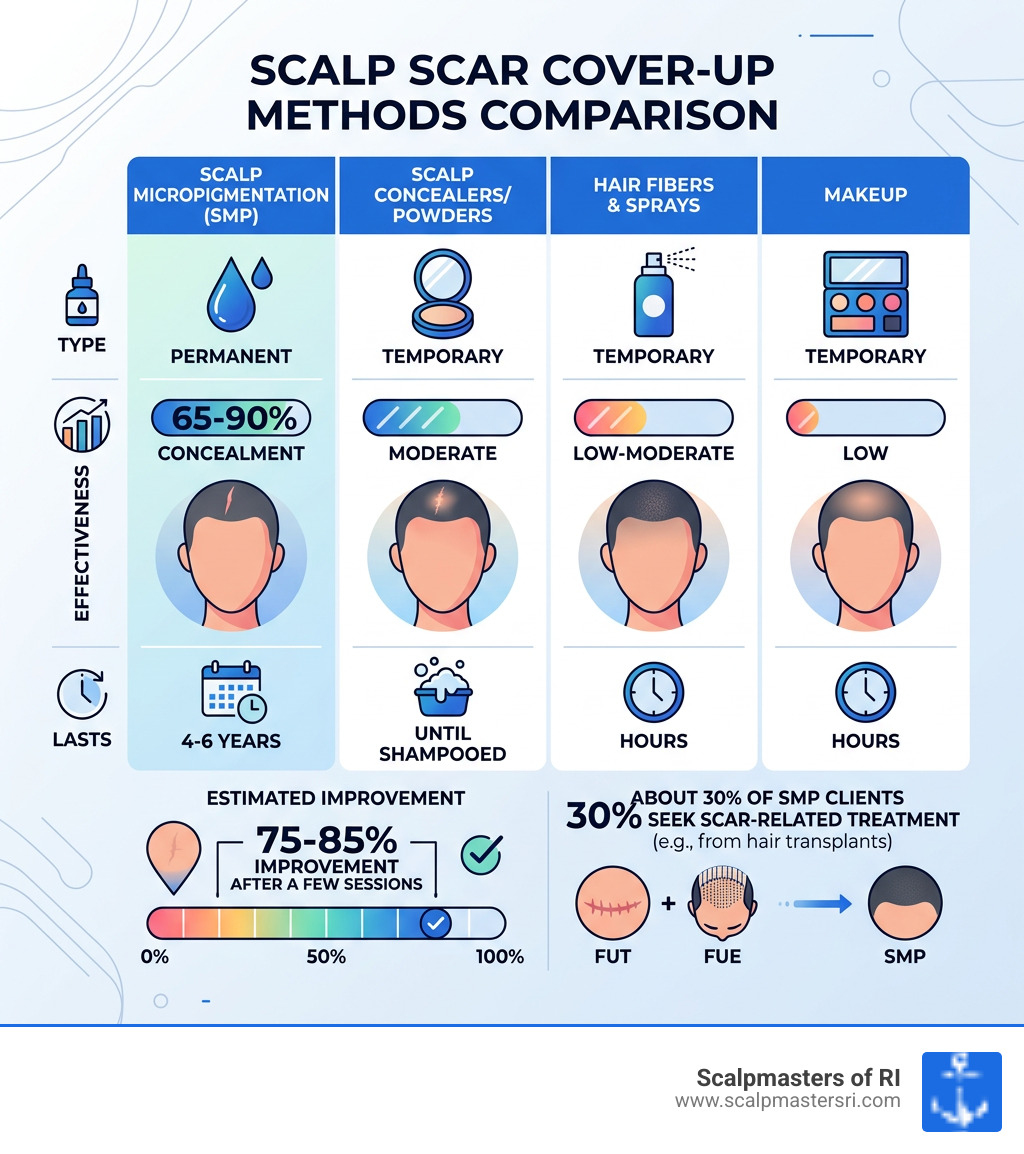
Here are the most effective options, from quickest to most permanent:
| Method | Type | Effectiveness | Lasts |
|---|---|---|---|
| Scalp micropigmentation (SMP) | Permanent | 65-90% concealment | 4-6 years |
| Scalp concealers / powders | Temporary | Moderate | Until shampooed |
| Hair fibers or sprays | Temporary | Low-moderate | Hours |
The short answer: Scalp micropigmentation (SMP) is the most effective long-term solution for hiding scalp scars. It deposits pigment into and around the scar tissue, replicating the look of natural hair follicles. Most people see a 75-85% improvement after just a few sessions.
Temporary options like concealers and makeup exist too — and they work well for day-to-day situations — but they require daily upkeep and don't address the root visual problem.
Scalp scars are more common than most people realize. About 30% of SMP clients seek treatment specifically for scar-related concerns , including those left behind by hair transplant procedures. The visible reminder of a scar — especially on the back of the head or along the hairline — can chip away at your confidence in a very real way.
This guide covers everything you need to know: what causes scalp scars, how SMP works to camouflage them, what to expect during treatment, and how temporary alternatives compare.
Understanding Scalp Scars: From FUT to FUE Procedures
To find the right scalp scar cover up, we first need to understand what we are dealing with. Not all scars are created equal, and the way a scar is formed dictates how it needs to be camouflaged.
The "Smile" Scar: Follicular Unit Transplantation (FUT)
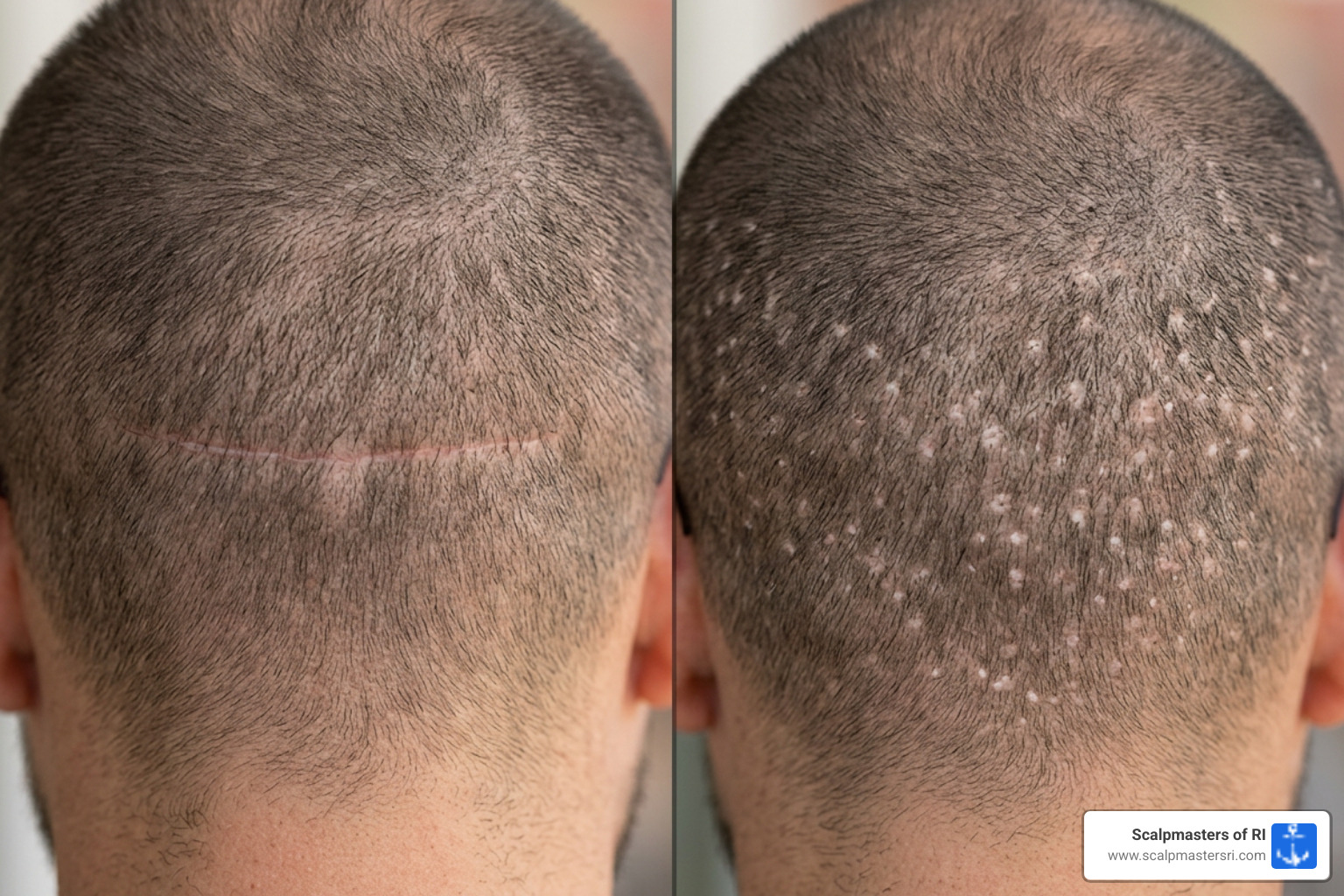
For many years, the gold standard of hair restoration was the FUT procedure, often called "strip harvesting." In this method, a long, thin strip of scalp is surgically removed from the back of the head (the donor site). The gap is then stitched together. While this allows for a high volume of grafts, it leaves behind a linear, horizontal scar.
Many men find themselves "trapped" by this scar; they can’t wear their hair short because the white line becomes glaringly obvious. This "smile" scar can vary in width depending on how the skin healed and the tension of the scalp.
The "Dot" Scars: Follicular Unit Extraction (FUE)
FUE is often marketed as "scarless," but that is a bit of a myth. Instead of one long line, FUE involves extracting individual hair follicles using a small punch tool. This leaves hundreds or even thousands of tiny, circular white dots across the donor area. While less noticeable than a strip scar when hair is long, these dots become very apparent if you decide to buzz your head or if your hair thins further over time.
Why Scars Stand Out
The primary reason a scalp scar is so visible isn't just the texture—it’s the color contrast. Scar tissue lacks the natural pigment of your skin and, more importantly, it lacks hair follicles. This creates a "dead zone" where the eye is immediately drawn to the smooth, pale surface against the textured, darker hair surrounding it. Furthermore, scars disrupt natural hair growth patterns, making the area look sparse or "glitchy."
According to the Cleveland Clinic, while various medical treatments can help improve the health or thickness of a scar, they rarely solve the visual "white line" problem. This is where specialized cosmetic solutions come into play.
Scalp Micropigmentation: The Best Permanent Scalp Scar Cover Up
If you are looking for a solution that doesn't involve daily reapplications of powders or more invasive surgery, Scalp Micropigmentation (SMP) is the industry leader. At Scalpmasters of RI, we see the transformative power of this "medical-grade" tattoo every day.
How SMP Works for Scars
SMP is a highly specialized process where we use micro-needles to deposit organic pigments into the dermal layer of the skin. Unlike a traditional tattoo, which goes deep and uses heavy inks that can "blur" over time, SMP uses specialized machines and pigments designed specifically for the scalp.
When we perform a scalp scar cover up, we aren't just "coloring in" the scar. We are meticulously replicating the appearance of individual hair follicles. By placing thousands of tiny dots inside the scar tissue and expertly blending them into the surrounding natural hair, we break up the visual "line" or "dots."
The Power of Statistics
The results speak for themselves. Statistics show that:
- 30% of SMP clients seek help specifically for hair transplant or injury scarring.
- Most clients experience a 75-85% improvement in the appearance of their scars.
- In many cases, concealment levels reach 65% to 90%, making the scar nearly undetectable to the naked eye.
For more detailed insights, you can explore our dedicated page on scalp micropigmentation for scars.
Benefits of SMP for Scalp Scar Cover Up
Why choose SMP over other methods? Here are the primary reasons our New England clients prefer it:
- Immediate Results: While it takes a few sessions to build the perfect density, you will see a massive difference the moment you walk out of your first appointment.
- Non-Surgical: There is no "going under the knife" again. No stitches, no anesthesia, and no new scars.
- Cost-Effective: Compared to the ongoing cost of expensive hair fibers or other invasive procedures, SMP is a smart long-term investment.
- Universal Compatibility: Whether you have fair skin, dark skin, or anything in between, we customize the pigment to match your natural hair color and skin tone perfectly.
- Long-Term Solution: Once the initial sessions are complete, the results typically last 4 to 6 years before a minor touch-up is needed.
Learn more about the specific benefits of SMP for scars and how it can restore your hairline and your confidence.
Comparing SMP to Temporary Scalp Scar Cover Up Methods
We understand that some people aren't ready for a permanent solution right away. There are several temporary scalp scar cover up products on the market, such as cosmetic powders or topical shaders.
These products work by "shading" the scalp to match your hair color. They are often used for a night out or a special event. However, they come with significant drawbacks:
- Daily Maintenance: You have to apply them every morning and wash them out at night.
- Mess Factor: They can smudge on pillows, hats, or during heavy sweating.
- The "Swim" Test: While some are water-resistant, few offer the total peace of mind that SMP provides when you're at the beach or the gym.
The SMP Treatment Journey: Sessions and Aftercare
At Scalpmasters of RI, we believe in a transparent process. We want you to know exactly what to expect when you visit our Cranston or Boston-area locations.
The Consultation
Every journey begins with a consultation. We assess the age, texture, and color of your scar. It is important to note that scars should generally be at least 6–12 months old and fully healed before we begin SMP. We also check if the scar is raised (keloid) or indented, as this affects how the light hits the area.
The Treatment Sessions
A typical scalp scar cover up requires 3 sessions, spaced about 10 to 14 days apart.
- Session 1: We lay the foundation, matching the pigment and creating a base layer of "follicles."
- Session 2: This is where the magic happens. We add density and begin the intricate blending process into the surrounding hair.
- Session 3: We fine-tune the details, ensuring the concealment is seamless and the color is perfect.
Each session usually lasts between 2 to 4 hours, depending on the size of the scar. As for discomfort? Most clients describe it as a 3 out of 10—much less painful than a traditional tattoo.
Aftercare: The Key to Longevity
Your aftercare is crucial for the pigment to settle correctly. We provide a strict but simple 4-day protocol:
- No Washing: Keep the area dry for the first 4 days.
- No Sweating: Avoid heavy workouts or saunas that cause excessive sweating.
- No Shaving: Give the skin time to heal without irritation.
- Sun Protection: Once healed, always use SPF to prevent the pigment from fading prematurely.
| Stage | What to Expect | Care Required |
|---|---|---|
| Days 1-4 | Mild redness, pigment looks dark | Keep dry, no sun, no scratching |
| Days 5-10 | Light flaking, redness disappears | Moisturize gently, no harsh chemicals |
| Days 14+ | Pigment settles into natural tone | Resume normal routine, use SPF |
Frequently Asked Questions about Scar Camouflage
How many sessions are needed for full scar coverage?
As mentioned, 3 sessions are the standard. Scar tissue is different from regular skin; it is often tougher and more "stubborn," meaning it may reject some pigment during the first pass. Layering the pigment over three sessions ensures we achieve the 75-85% improvement our clients expect.
How long does SMP last on scalp scars?
On average, SMP lasts 4 to 6 years. Because the immune system slowly breaks down the pigment over time, you will eventually notice a slight lightening. A quick "touch-up" session every few years is all it takes to keep the camouflage looking fresh.
Can SMP cover raised or indented scars?
Yes, but with a caveat. SMP is a color-based solution. It is incredibly effective at removing the "white line" contrast. However, it does not change the physical texture of the skin. If a scar is significantly raised or deeply indented, a shadow may still be visible under certain harsh lighting. That said, even with textured scars, most clients still see a 65-90% improvement in overall concealment.
Conclusion: Restore Your Confidence with Scalpmasters of RI
A scalp scar doesn't have to be a permanent blow to your self-esteem. Whether you're dealing with a legacy FUT strip, FUE dots, or an injury from years ago, there is a solution that works.
At Scalpmasters of RI, we combine technical precision with an artistic eye to deliver the highest quality scalp scar cover up in New England. Our founder’s extensive experience ensures that every dot is placed with purpose, creating a natural look that lets you forget the scar was ever there. From our clinic in Cranston to our reach across Rhode Island, Massachusetts, and Connecticut, we are dedicated to helping you look and feel your best.
Ready to leave the hats and concealers behind? Schedule your scalp micropigmentation for scars consultation today and take the first step toward a scar-free reflection.
Learn More
What's New
Latest Hair Loss Solutions & Guides