Advanced Scar Camouflage: Everything You Need to Know
What Is Permanent Scar Camouflage — and Can It Help You?
Permanent scar camouflage is a paramedical tattooing technique that uses custom-blended, skin-toned pigments to blend the appearance of scars into the surrounding skin. It won't erase a scar completely — but it can make it dramatically less noticeable.
Here's a quick summary of what you need to know:
| Question | Quick Answer |
|---|---|
| How does it work? | Skin-toned pigments are tattooed into the scar to reduce color contrast |
| Who is it for? | People with flat, fully healed scars that are lighter than surrounding skin |
| How long do results last? | Typically 3–5 years before a touch-up is needed |
| How many sessions? | Usually 2–4 sessions, spaced 8–12 weeks apart |
| Does it hurt? | Mild discomfort — most people rate it a 3 or 4 out of 10 |
| Will the scar disappear? | No, but it can become far less visible |
| Is it safe? | Yes, when performed by a certified paramedical professional |
Scars — from surgery, injury, or burns — can affect more than just your skin. They can change how you feel about yourself every single day. Many people spend years covering up with clothing, makeup, or photo editing before discovering that a long-term solution exists.
Scar camouflage has been practiced in clinical and hospital settings for decades, helping burn survivors, post-surgical patients, and people with hypopigmentation rebuild their confidence with a natural-looking result.
This guide walks you through everything — from how the procedure works, to whether your scar qualifies, to what real results look like.
Understanding Permanent Scar Camouflage and How It Works
At its core, permanent scar camouflage is a specialized form of medical micropigmentation. While it shares some tools with traditional tattooing, the goal and technique are entirely different. Instead of creating art on the skin, we are performing a restorative procedure designed to mimic the natural variations of your skin tone.
When we perform this treatment, we use a fine needle attached to an electrical device to deposit pigments into the upper dermis layer of the skin. Unlike traditional tattoo inks, which are designed to be bold and saturated, paramedical pigments are often iron-free and custom-blended to match your unique skin undertones. This ensures that as the pigment settles, it looks like real skin rather than a flat "patch" of color.
The science behind it is fascinating. We aren't just "painting" over the scar; we are strategically building layers of color to break up the visual contrast between the white or pale scar tissue and the surrounding healthy skin. For those dealing with hair loss due to scarring on the scalp, we often utilize SMP for Scars to replicate the look of hair follicles, further masking the area.
When to Choose Permanent Scar Camouflage for Surgical Scars
Surgery is often a necessary part of life, but the reminders it leaves behind don't have to be. We frequently see clients in our Rhode Island and Massachusetts clinics looking to address scars from common procedures:
- Tummy Tucks and C-Sections: These often leave long, linear scars across the abdomen that can be significantly lightened or "hypopigmented."
- Mastectomy and Breast Augmentation: We can camouflage surgical lines around the areola or along the breast tissue.
- Facelifts: Scars hidden near the hairline or ears can be blended so they are nearly invisible to the naked eye.
The best candidates for surgical scar camouflage are those whose scars have reached "color stability." This means the scar is no longer pink or red, but has turned white or pale. If you have scarring on the scalp from a hair transplant or injury, you can find more info about scalp micropigmentation for scars to see how we blend those specific areas.
Candidacy: Is Your Scar Ready for Treatment?
Timing is everything in permanent scar camouflage. We follow a strict "12-month rule." A scar must be at least one year old before we can safely treat it. Why the wait? Because scar tissue is "living" tissue that continues to change deep beneath the surface long after the wound has closed.
To be a good candidate, your scar should meet these criteria:
- Maturity: At least 12–18 months old.
- Color: Lighter than the surrounding skin (hypopigmented).
- Texture: Flat or nearly flat.
- Stability: Not itchy, painful, or changing in appearance.
Treatable Scars vs. Contraindications
Not all scars are suitable for pigment implantation. For example, keloids (raised, thick scars that grow beyond the original wound) are generally a contraindication because the trauma of the needle could trigger more growth. Similarly, hyperpigmented scars (those darker than your skin) usually require different dermatological treatments before tattooing can be considered.
| Treatable Scars | Contraindications (Wait or Avoid) |
|---|---|
| Mature surgical scars (12+ months) | Fresh scars (less than 1 year old) |
| Stable, white stretch marks | Keloid or highly raised scars |
| Pale burn scars | Scars with dark/purple edges (PIHP) |
| Fully healed trauma/injury scars | Active skin conditions (eczema, psoriasis) |
| Vitiligo (in remission for 3+ years) | Port wine stains (without medical clearance) |
According to scientific insights on scar camouflage, the integrity of the skin is paramount. If the skin is too thin or unstable, it won't hold the pigment correctly.
Inked vs. Inkless Permanent Scar Camouflage
You may have heard of "inkless" scar treatments. This is a slightly different approach where we use a similar tattooing device but instead of pigment, we infuse the skin with a specialized healing serum. This process, often called collagen induction therapy, stimulates the body’s natural skin remodeling process.
- Inkless: Best for improving the texture of raised or slightly bumpy scars and stretch marks. It encourages the skin to produce its own collagen and elastin.
- Inked: Best for color correction. If the texture is fine but the color is too white, we use custom-matched pigments to blend it in.
In many cases, we may recommend a combination approach: starting with inkless sessions to smooth the texture, followed by inked sessions to perfect the color.
The Procedure: What to Expect During Your Sessions
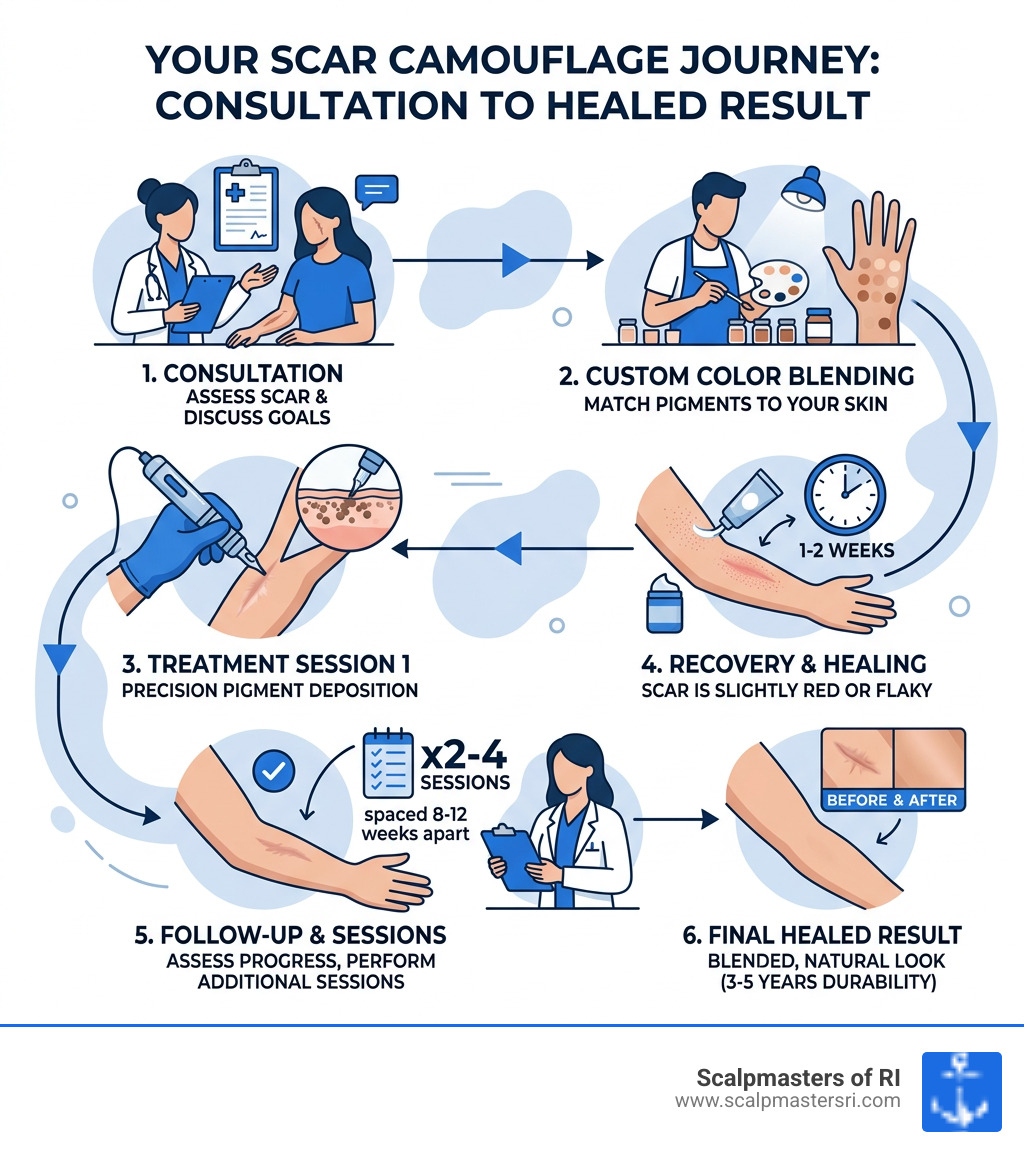
Walking into your first session can feel a bit nerve-wracking, but we aim to make the process as relaxing as possible. A typical session lasts anywhere from 1.5 to 4 hours, depending on the size of the area.
The Multi-Session Journey
It is a myth that permanent scar camouflage is a "one-and-done" deal. Because scar tissue is different from healthy skin—it's denser and has less blood flow—it tends to reject pigment more easily. Statistics show that scarred skin can reject 30–50% of the pigment during the initial healing phase.
- Number of Sessions: Typically 2 to 4 sessions.
- Spacing: We space sessions 8 to 12 weeks apart. This allows the skin to fully heal and the pigment to "settle" so we can see exactly how much more color is needed.
- The Sensation: Most clients describe it as a light scratching or a rhythmic vibration. We use high-quality topical anesthetics to keep the pain level around a 3 or 4 out of 10.
Aftercare and Long-Term Results for Permanent Scar Camouflage
How you treat your skin in the weeks following your appointment is just as important as the procedure itself. Immediately after the session, the area will look red, swollen, and much darker than the final result. Don't panic! This is a normal part of the inflammatory response.
The Healing Timeline
- Days 1–3: Redness and slight swelling. We often recommend keeping the area clean and applying a thin layer of specialized ointment.
- Days 4–7: Light scabbing or flaking may occur. It is vital that you do not pick at these! Picking can pull the pigment out of the skin.
- Weeks 4–6: The "disappearing act." Sometimes the pigment seems to vanish as the new skin grows over it.
- Weeks 8–12: The true color emerges, and we can evaluate if a touch-up is needed.
Longevity and Maintenance
While we call it "permanent," the reality is that the human body is constantly regenerating. Pigment retention typically lasts between 3 to 5 years. Factors like sun exposure, skin type, and your body's metabolic rate will affect how quickly the pigment fades.
To protect your investment, sunscreen is your best friend. UV rays break down tattoo pigments, so applying a high-SPF block whenever you're out in the New England sun will keep your results looking fresh for much longer.
Frequently Asked Questions about Scar Camouflage
Does scar camouflage hurt?
We get this question every day! Most people are pleasantly surprised. While "pain" is subjective, the needles used in paramedical tattooing are very fine. It feels more like a tingle or a "cat scratch" than a deep needle poke. If you've ever had a regular tattoo, this is significantly less painful.
Will the scar completely disappear?
We believe in being 100% honest with our clients. Permanent scar camouflage is about improvement , not erasure. While we can often achieve an 80–90% improvement in appearance, the texture of the scar will still be there if you run your finger over it. Our goal is to remove the "visual target" so that when someone looks at you, their eyes don't immediately jump to the scar.
What happens to the tattoo when I tan?
This is a crucial point to understand. Traditional skin tans because of melanin production. Tattoo pigment does not contain melanin, so it will not change color when you tan.
If you get a deep tan, your natural skin will get darker, but the camouflaged scar will stay the same color, which might make the scar appear lighter again. This is why we always match the pigment to your "natural," non-tanned skin tone. We recommend wearing sunscreen not just to protect the pigment, but to keep the contrast between your tanned skin and the treated scar to a minimum.
Conclusion
At Scalpmasters of RI, we understand that a scar is more than just a mark on the skin—it’s a story you might not want to tell every time you look in the mirror. Whether you are in Cranston, Boston, or anywhere in the New England area, our goal is to provide a professional, artistic, and compassionate environment for your transformation.
Using advanced permanent scar camouflage techniques, we help you reclaim your skin and your confidence. Every scar is unique, which is why we offer personalized consultations to create a roadmap tailored specifically to your skin's needs.
Are you ready to stop hiding? Schedule your consultation for scalp micropigmentation for scars or body scar camouflage today and take the first step toward feeling like yourself again.
Learn More
What's New
Latest Hair Loss Solutions & Guides