
From Sparse to Superb: A Man's Guide to Hair Density
Understanding Male Hair Density: What It Means for Your Hair's Appearance
Male hair density is the number of hair strands per square centimeter of your scalp. If your scalp is showing through or your hair looks thinner, understanding density is the first step toward addressing it.
Quick Answer: What You Need to Know About Male Hair Density
- Normal Range: Healthy adult males typically have 100-200 hairs per square centimeter.
- What It Measures: The number of visible hair shafts, which is different from hair thickness (the width of each strand).
- Why It Matters: Lower density means more visible scalp and less volume.
- Key Fact: You can lose up to 50% of your hair before thinning becomes visibly noticeable.
- Variation: Density differs by scalp location, ethnicity, and age.
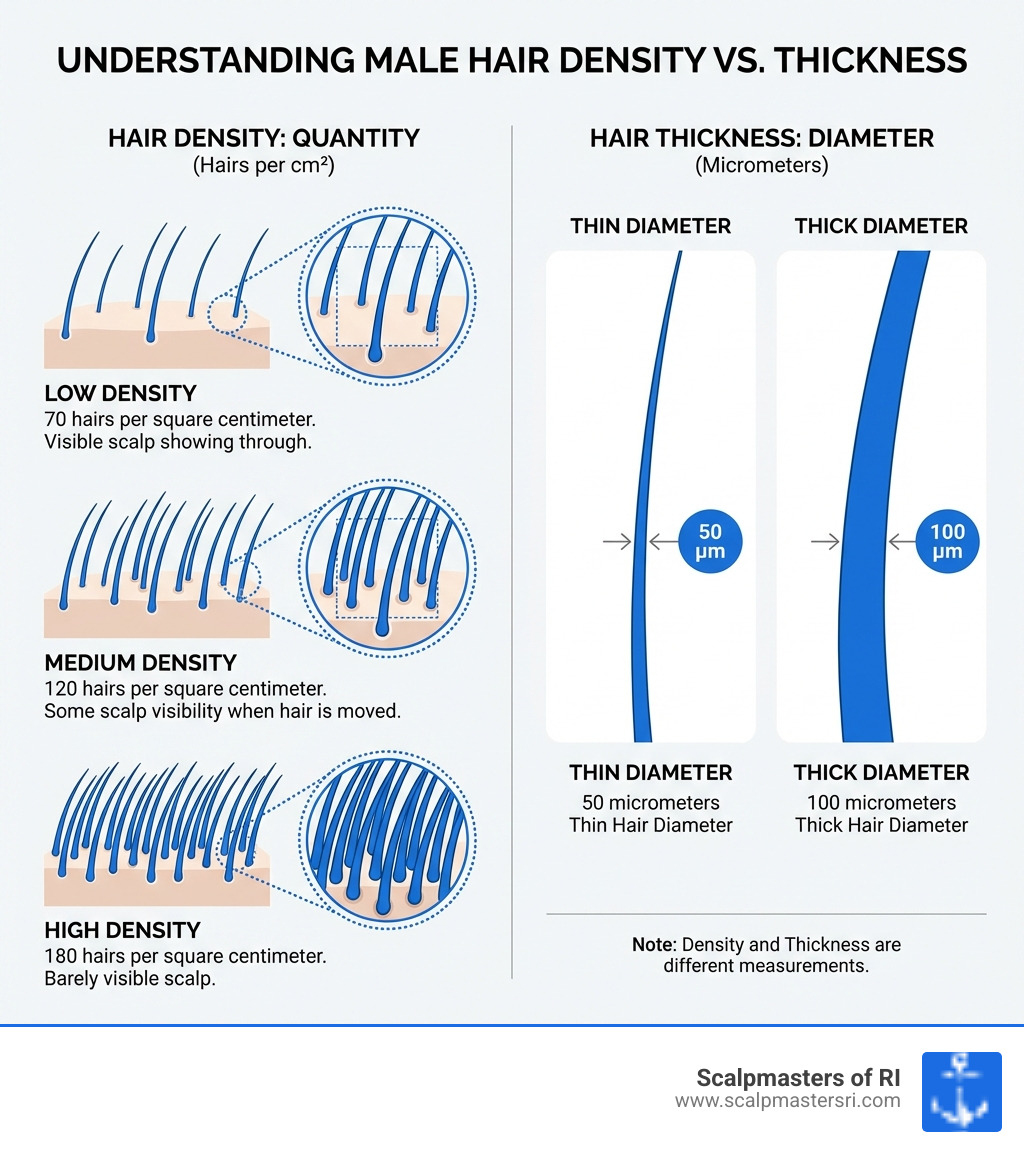
It's crucial to distinguish between density (quantity) and thickness (quality). You can have fine hair with high density that looks full, or thick strands with low density that reveals your scalp. This distinction is key to finding the right solution.
Research shows that in healthy men, density ranges from about 117 to 140 hairs/cm², with the back of the head typically having more hair than the temples. With age or pattern baldness, these numbers can drop to as low as 20-50 hairs/cm² in affected areas. This guide will help you assess your hair density and explore options to improve its appearance.
Decoding Hair Density: The Key Metrics
To understand your hair, know the key terms:
- Hair Density: The number of individual hair strands per square centimeter of your scalp. Higher density creates a fuller look.
- Hair Follicle Density: The number of hair follicles (the organs that grow hair) per square centimeter. This number is always higher than visible hair density, as not all follicles are active at once.
- Hair Thickness (Caliber): The diameter of an individual hair strand, ranging from fine to coarse.
- Hair Life Cycle: The cycle of growth (anagen), transition (catagen), and rest (telogen) that each follicle undergoes. About 85-90% of your hair is typically in the growth phase. You can read more about the hair growth cycle in this overview from the National Center for Biotechnology Information.
These factors work together. You can have fine hair (low thickness) but high density, creating a voluminous look, or thick strands but low density, making the scalp more visible.
| Feature | Hair Density | Hair Thickness |
|---|---|---|
| Definition | Number of hairs per square centimeter of scalp | Diameter (girth) of an individual hair strand |
| Measurement | Hairs/cm² or hairs/inch² | Micrometers (µm) |
| Impact on Look | Contributes to overall fullness and scalp coverage | Affects the body, strength, and feel of hair |
| Variability | Varies by age, ethnicity, and scalp location | Varies by ethnicity and individual genetics |
| Key Insight | Can be low with thick hair, or high with fine hair | Doesn't directly indicate how much hair you have |
What is Normal Male Hair Density?
"Normal" male hair density varies, but healthy adults generally have 100 to 200 hairs per square centimeter. This number is influenced by several factors:
- Ethnicity: Studies show Caucasians generally have the highest hair density, while people of African descent tend to have the lowest. Asian individuals often have the thickest hair strands. A review in the International Journal of Trichology discusses these differences in more detail.
- Age: We are born with a high follicle density (around 1,100 follicles/cm²) that naturally declines with age. By the third decade, it drops to about 600/cm², and further in later years. This is a natural part of aging as the scalp surface area also increases. Age-related changes in hair density are summarized in this research on hair density and age.
- Scalp Location: Density isn't uniform. It's typically highest at the crown (vertex) and back of the head (occiput), and lowest at the temples. The occipital area's robustness is why it's often used as a donor site for hair transplants, with densities ranging from 124–200 hairs/cm².
The Relationship Between Hair Follicles and Hair Density
Hair follicles are the foundation of your hair density. Hair grows in small groups called follicular units, containing 1 to 4 hairs each. As we age, the number of active follicles decreases. In conditions like male pattern baldness, follicles undergo miniaturization—they shrink and produce thinner, weaker hairs (vellus hairs) instead of strong terminal hairs. This process dramatically reduces visible male hair density even if the follicle count remains the same. The hair life cycle also plays a role; a higher percentage of hairs in the anagen (growth) phase leads to better visible density.
What Causes a Decrease in Male Hair Density?
A drop in male hair density can be disheartening. While several factors can contribute, one is the most common cause.

The Primary Culprit: Androgenetic Alopecia
For most men, the cause of reduced hair density is Androgenetic Alopecia (AGA), or male pattern baldness. This genetic condition affects millions of men in New England and worldwide.
- Pattern and Miniaturization: AGA follows predictable patterns, like a receding hairline or thinning crown (vertex), as classified by the Hamilton-Norwood scale. The core issue is hair follicle miniaturization, where follicles shrink and produce progressively thinner, shorter hairs until they stop producing hair altogether.
- Genetics and DHT: AGA is largely inherited. The primary trigger is dihydrotestosterone (DHT), a hormone converted from testosterone by the enzyme 5-alpha reductase. In genetically predisposed men, hair follicles are hypersensitive to DHT, which causes them to miniaturize. For a deeper medical overview, see this article on androgenetic alopecia.
Lifestyle, Diet, and Environmental Factors
While genetics are the primary cause, other factors can accelerate or contribute to thinning hair:
- Nutrient Deficiencies: A lack of essential nutrients like protein, biotin, iron, and zinc can disrupt hair growth.
- Stress: Chronic stress can cause excessive shedding, a condition known as telogen effluvium.
- Smoking: Smoking impairs blood flow to the scalp, starving follicles of vital nutrients and has been linked to increased hair loss.
- Poor Diet: A "Western diet" high in processed foods and sugar can contribute to inflammation that negatively impacts hair health. In contrast, a Mediterranean diet has been associated with a lower risk of AGA; one clinical paper discusses this relationship in detail.
- UV Exposure: Prolonged sun exposure can damage hair strands and the scalp, potentially contributing to thinning.
Other Medical Conditions and Causes
Beyond AGA, other issues can reduce male hair density:
- Telogen Effluvium: A temporary but significant hair shedding caused by a shock to the system, such as severe illness, surgery, or stress.
- Alopecia Areata: An autoimmune condition where the immune system attacks hair follicles, causing patchy or diffuse hair loss.
- Thyroid Issues: Both overactive and underactive thyroid conditions can disrupt hormones and lead to hair thinning.
- Medications: Certain drugs for blood pressure, depression, and other conditions can have hair loss as a side effect.
- Scalp Conditions: Fungal infections (tinea capitis) or inflammatory issues (psoriasis, seborrheic dermatitis) can damage follicles and reduce density.
How to Assess and Measure Your Hair Density
Understanding your current male hair density is the first step toward managing it. You can perform simple checks at home or seek a professional evaluation for an accurate assessment.
Simple At-Home Visual Assessment
These methods can give you a general idea of your hair density:
- Scalp Visibility Test: Part your hair. If you can easily see your scalp, you likely have low density. If you can only see it with some effort, you have medium density. If your scalp is barely visible, you have high density.
- Ponytail Test (for longer hair): If your hair is long enough, tie it back. A ponytail circumference of less than 2 inches suggests low density, 2-3 inches is medium, and 4 inches or more is high.
- Photograph Comparison: Taking regular photos from the same angles is a great way to track changes in density over time.
Understanding Your Current Male Hair Density with Professional Tools
For an accurate assessment, especially if you're concerned about hair loss, a professional evaluation is best.
- Dermatologist Consultation: A hair loss specialist can diagnose the cause of thinning and recommend appropriate actions.
- Trichoscopy: This non-invasive method uses a magnifying device to examine hair follicles, shaft thickness, and density without pulling hair. It's excellent for diagnosing conditions like androgenetic alopecia.
- Phototrichogram: Considered the "gold standard," this technique involves taking magnified photos of a small scalp area to precisely count hairs, measure their diameter, and determine growth phases. A dermatologic reference text describes the method as the gold standard for measuring hair density.
- Scalp Biopsy: In some cases, a tiny piece of scalp tissue is removed for microscopic examination to get detailed information about follicle health and diagnose specific types of alopecia.
- Measuring Hairs per cm²: Professionals quantify male hair density by counting hairs in a measured area. This provides a baseline to track changes. Mild thinning often starts when density drops to 70-100 hairs/cm², while severe thinning can be as low as 20-50 hairs/cm².
Strategies to Improve the Appearance of Hair Density
If you're looking to improve your male hair density, whether to combat thinning or boost fullness, you have several effective options. These range from non-invasive cosmetic solutions to lifestyle adjustments.
Scalp Micropigmentation (SMP) for Density Improvement
For many men in Rhode Island, Cranston, Massachusetts, and Boston, Scalp Micropigmentation (SMP) offers an immediate and highly effective solution for improving the appearance of male hair density. It is a non-surgical, cosmetic procedure that creates the illusion of a fuller head of hair.
- How SMP Works: SMP uses specialized micro-needles to deposit thousands of tiny pigment dots into the scalp. These dots are matched to your hair color and follicle size, perfectly mimicking the look of natural hair follicles.
- Creating the Illusion of Density: By reducing the color contrast between your hair and scalp, these pigment dots make your existing hair appear denser and thicker. It's like adding thousands of tiny shadows that fill in the gaps, creating a more uniform and robust look.
- Benefits for Thinning Hair:
- Instant Results: See a noticeable improvement in density after just one session.
- Natural Appearance: When done by a skilled artist, SMP blends seamlessly with your hair. Our founder's artistry at Scalpmasters of RI ensures precise, confidence-restoring results.
- Non-Invasive: SMP requires no incisions or downtime.
- Low Maintenance: The treatment requires minimal upkeep, usually just a touch-up every few years.
- Confidence Boost: Clients report a significant increase in self-esteem after their SMP treatment.
- Suitable Candidates: SMP is an excellent option for men with diffuse thinning, receding hairlines, or those who want to add density to existing hair.
To learn more, explore our pages on Scalp Micropigmentation for Hair Density and Scalp Micropigmentation Thinning Hair.
Lifestyle and Hair Care Approaches
Supporting your hair density also involves daily habits and care.
- Healthy Diet: Fuel your hair with a balanced diet rich in protein, vitamins (B vitamins, C, D), and minerals (iron, zinc). General guidelines for hair-supporting nutrition are discussed in this review on diet and dermatology.
- Stress Management: Reduce chronic stress through activities like meditation, exercise, or hobbies.
- Gentle Hair Care: Avoid excessive heat styling, tight hairstyles, and harsh chemical treatments. Use mild, sulfate-free shampoos.
- Scalp Health: Keep your scalp clean and consider gentle massages to stimulate blood flow.
Frequently Asked Questions about Male Hair Density
Here are answers to some of the most common questions we hear from men concerned about their hair.
How does male hair density compare to female hair density?
While both men and women can experience thinning, there are key differences in density, patterns, and hormonal causes.
- Density Ranges: Men and women start with similar hair density, though some studies suggest women may have slightly higher averages in certain scalp areas.
- Hair Loss Patterns: Men typically experience male pattern baldness (a receding hairline and thinning crown) as defined by the Norwood scale. Women more often have female pattern hair loss (FPHL), which is diffuse thinning across the top of the scalp, with the front hairline often preserved (Ludwig scale).
- Hormonal Differences: In men, DHT is the primary hormone driving hair loss. In women, the hormonal interplay is more complex and involves the enzyme aromatase, which converts androgens to estrogens. A clinical review on female pattern hair loss explains these differences in more detail.
Does hair density naturally vary across the scalp?
Yes, male hair density is not uniform across the scalp.
- High-Density Areas: The crown (vertex) and the back of the head (occipital region) typically have the highest hair density. The occipital region is famously resistant to DHT, which is why it's used as the donor area for hair transplants.
- Low-Density Areas: The temples (temporal regions) naturally have the lowest hair density in men and are often the first areas to show thinning in male pattern baldness.
This natural variation is critical for hair restoration professionals to create a natural-looking result. Research on regional density patterns is summarized in this paper on scalp location and hair density.
At what point is low hair density considered balding?
The transition from "thinning" to "balding" is gradual, but there are clear signs.
- The 50% Rule: A surprising fact is that you can lose up to 50% of your male hair density before thinning becomes obvious to the naked eye.
- Visual Cues: The most common signs are a widening part line and the scalp becoming easily visible through your hair.
- Norwood Scale: For men, balding is formally classified using the Norwood-Hamilton scale, which outlines seven stages of progression. You can see a general overview on the Norwood scale.
- Clinical Thresholds: From a clinical view, thinning is defined by specific densities:
- Mild Thinning: 70 to 100 hairs/cm².
- Moderate Thinning: 50-70 hairs/cm².
- Severe Thinning: Below 50 hairs/cm², indicating obvious thinning that warrants action.
Conclusion
Understanding male hair density is key to managing your hair's appearance and health. We've covered what density is, how it's measured, and the primary causes of its decline, especially androgenetic alopecia.
The good news is that effective solutions are available. While lifestyle and diet play a supportive role, for many men in Rhode Island, Cranston, Massachusetts, and Boston, Scalp Micropigmentation (SMP) offers a remarkable, non-surgical path to reclaiming the look of a fuller head of hair. By creating a natural illusion of density, SMP can help you feel more confident.
At Scalpmasters of RI, we pride ourselves on our founder's artistry, delivering precise, confidence-restoring results. If you're ready to transform your look, we invite you to explore the possibilities.
Ready to learn more about how we can help you achieve the appearance of superb male hair density? Visit our SMP for Men page or dive deeper into Scalp Micropigmentation Thinning Hair. You can also find the many Benefits of Scalp Micropigmentation for Hair Loss and find out Is SMP Right For You? For a comprehensive overview, check out Everything You Need to Know About Scalp Micropigmentation and our Step-by-Step Guide on How Scalp Micropigmentation Works.
Don't let thinning hair hold you back. Let us help you go from sparse to superb! Visit our pillar page to learn more about our services: SMP for Men
Learn More
What's New
Latest Hair Loss Solutions & Guides