The Ultimate Guide to Uneven Hairlines
Understanding Uneven Hairlines: What You Need to Know
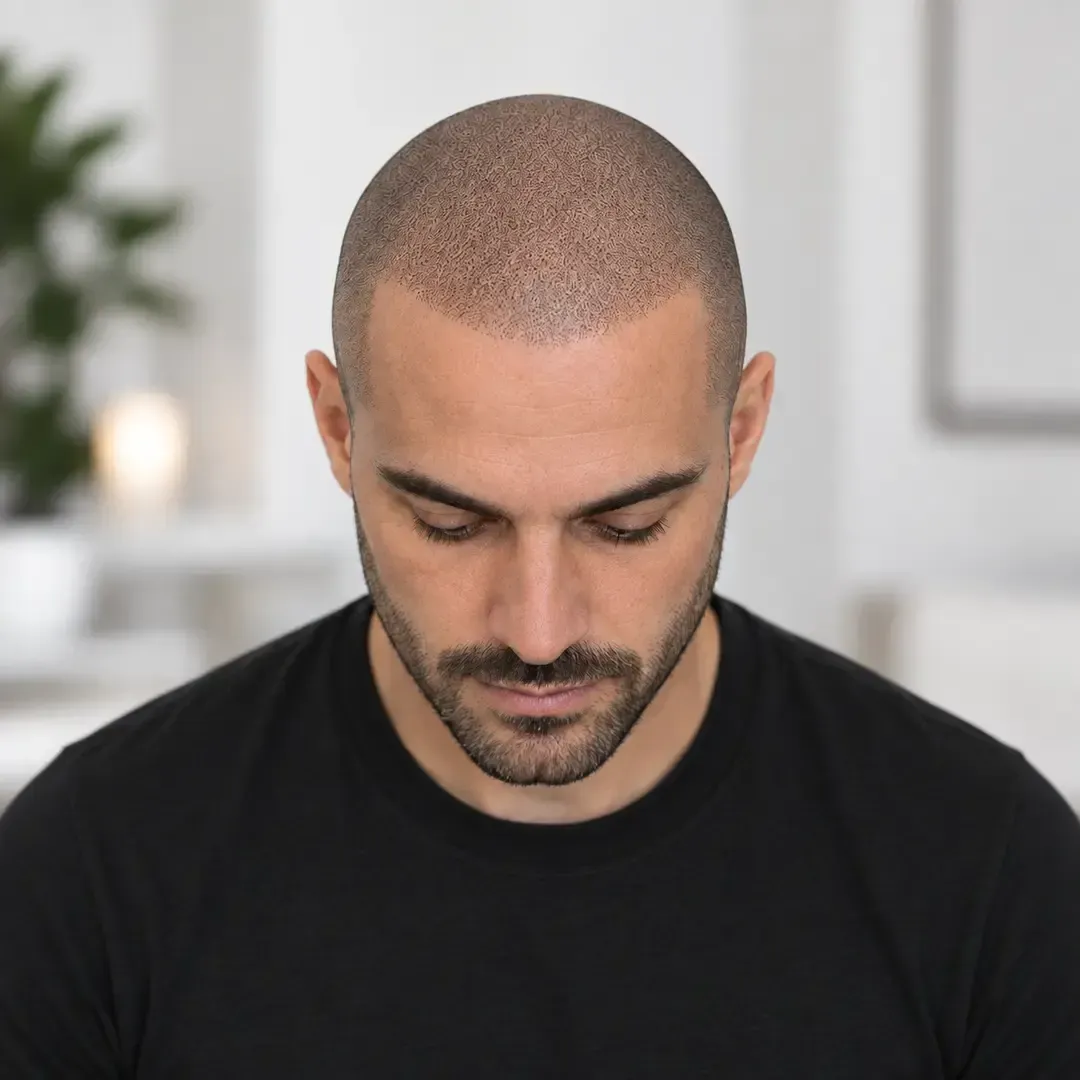
An uneven hairline is an asymmetrical hairline where one side sits higher, thinner, or more receded than the other. It's one of the most common concerns people notice when they look in the mirror or review recent photos.
Quick Answer: Key Facts About Uneven Hairlines
- What it is: Asymmetry in your hairline where one temple or side appears higher or thinner than the other
- Is it normal? Yes—most people have some degree of natural hairline asymmetry
- Common causes: Genetics, male pattern baldness, aging, tight hairstyles, stress, or physical trauma
- Does it mean you're balding? Not always—it depends on speed of change, family history, and other symptoms
- Can it be fixed? Yes—through styling adjustments, lifestyle changes, or cosmetic solutions like Scalp Micropigmentation
If you've recently noticed that one side of your hairline looks different from the other, you're not alone. Research shows that up to 25% of men experience noticeable hair loss by age 21, and uneven recession is often one of the earliest signs people detect.
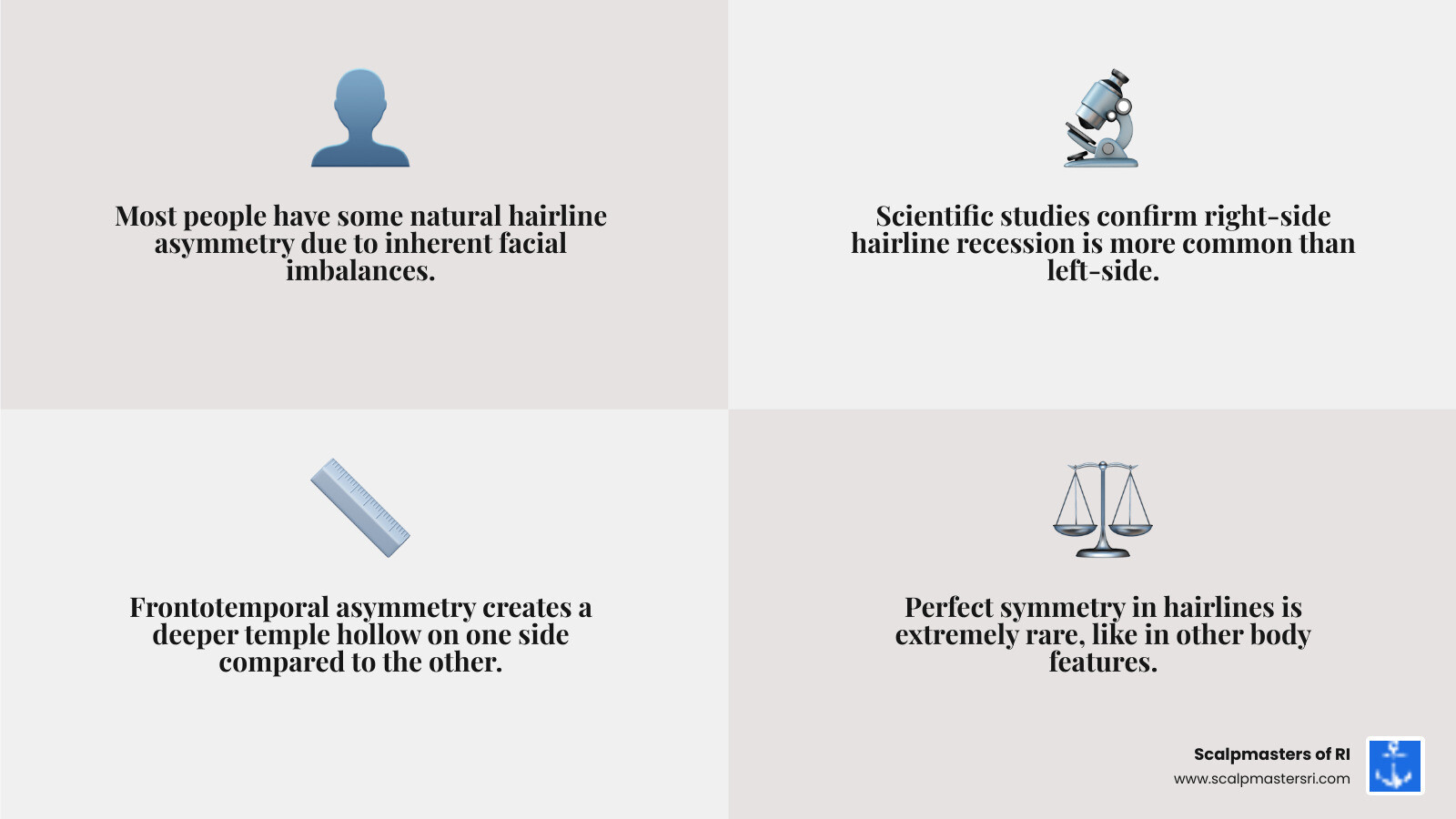
The truth is, perfectly symmetrical hairlines are extremely rare. Just like how your face, hands, and other body parts have natural asymmetry, your hairline likely does too. But understanding when an uneven hairline signals a real problem versus when it's just your natural anatomy can help you decide if—and how—to address it.
This guide breaks down everything you need to know about uneven hairlines: what causes them, how to tell if yours is normal or a sign of progressive hair loss, and what solutions exist—from simple hairstyling tricks to advanced cosmetic procedures.
What is an Uneven Hairline?
At its core, an uneven hairline refers to a lack of symmetry between the left and right sides of your scalp. You might notice a deeper "hollow" at your right temple than your left, or perhaps the hair on one side feels significantly thinner. This imbalance is technically known as frontotemporal asymmetry.
While it can feel like a major aesthetic flaw when you’re staring at it in the bathroom mirror, it’s important to remember that the human body is rarely perfectly symmetrical. Scientific research on facial and body asymmetry indicates that most people possess some degree of left-right unevenness in their faces and even their internal organs. Your hairline is no exception. In fact, some researchers have noted that a right-side hairline imbalance may be more common than a left-side one.
Is it a medical emergency? Usually, no. Is an Uneven Hairline Normal? Absolutely. For many, this is simply how their hair grows. However, if the asymmetry is new or rapidly progressing, it could be a sign that your follicular density is changing due to external or internal factors.
The Role of Genetics in an Uneven Hairline
If you’re wondering why your hairline looks a certain way, the best place to look is often your family tree. Genetics play the most pivotal role in determining the shape, height, and symmetry of your hairline. Just as you might inherit your father’s nose or your mother’s eyes, you can inherit a specific hereditary pattern of hair growth.
DNA expression dictates how your follicles are distributed. For some, this manifests as a classic widow's peak—a V-shaped point in the center of the forehead—which can sometimes appear uneven if the peak is slightly off-center. If you’ve had a "crooked" hairline since childhood, it’s almost certainly just your genetic blueprint at work. Understanding this can be a relief; if it’s always been that way, it’s likely not a sign of active balding. You can find more details on managing these genetic traits in our guide on Got Uneven Hairline? Here’s What You Can Do.
Natural Aging and Hormonal Shifts
As we age, our bodies undergo physiological maturation that directly impacts our hair. The primary culprit behind changes in the hairline is Dihydrotestosterone (DHT), a byproduct of testosterone. Hair follicles in the temple area often have a high concentration of androgen receptors, making them particularly sensitive to DHT.
When DHT attaches to these receptors, it can cause the hair growth cycle to shorten, leading to thinner, shorter hairs until they eventually stop growing altogether. This process doesn't always happen at the same speed on both sides of the head. Research on age-related hairline patterns shows that hormonal shifts can cause one side to recede faster than the other.
Statistic we mentioned earlier? Up to 25% of men see noticeable hair loss by age 21. This isn't always "balding" in the traditional sense; often, it is the transition from a juvenile hairline to a mature one.
Common Causes of an Uneven Hairline
While genetics and aging are the heavy hitters, several other factors can contribute to an uneven hairline. Identifying the root cause is the first step toward finding the right solution.
- Androgenetic Alopecia: Also known as male or female pattern baldness. In men, this often starts at the temples and can progress asymmetrically.
- Traction Alopecia: This is caused by repeated tension on the hair follicles. If you consistently part your hair on one side or pull it back tightly, you may notice more loss on the side experiencing the most "pull."
- Physical Trauma: Scars from injuries or surgeries (like facelifts) can leave permanent gaps in the hairline, creating an uneven look.
- Scarring Alopecia: A group of rare disorders that destroy hair follicles and replace them with scar tissue.
- Lifestyle Factors: High levels of stress and nutritional deficiencies (like a lack of iron, protein, or biotin) can lead to telogen effluvium—a temporary thinning that may appear more prominent on one side of the head.
A scientific study on receding hairline asymmetry confirms that even in the early stages of androgenetic alopecia, asymmetry is quite common. To learn more about protecting your hair from these factors, check out our tips on How to Prevent Receding Hairline.
Traction Alopecia and Styling Damage
We love a good man bun or a sleek braid as much as anyone in New England, but your hair follicles might disagree. Traction alopecia is a gradual form of hair loss caused by a pulling force. Over time, this constant tension can damage the follicle to the point where it stops producing hair.
If you are a fan of tight hairstyles, you might notice that your uneven hairline correlates exactly with where the tension is highest. Chemical processing and excessive heat damage can also weaken the hair shaft, leading to breakage that mimics the appearance of a receding hairline. Finding the Right Barber for Your Receding Hairline is crucial; a professional who understands hair health can help you choose styles that minimize stress on your edges.
Maturing vs. Receding: Is Your Hairline a Sign of Balding?
This is the million-dollar question for most men in their 20s and 30s. There is a significant difference between a hairline that is simply "maturing" and one that is "receding."
A maturing hairline is a natural part of the aging process. Between the ages of 18 and 30, most men’s hairlines will move back about 1 to 2 cm from their original "juvenile" position. This transition usually stabilizes and doesn't involve significant thinning at the crown.
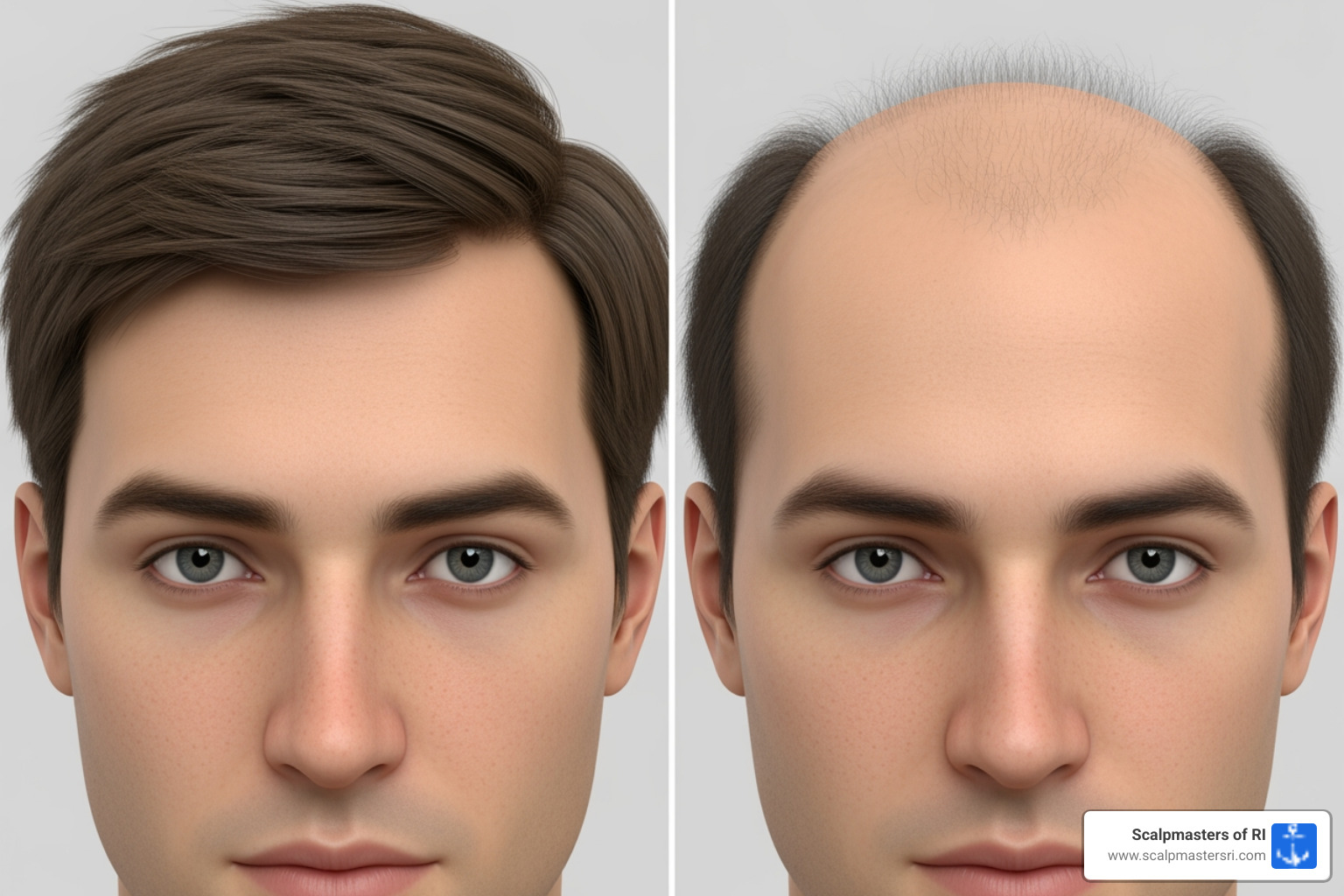
A receding hairline, however, is the beginning of androgenetic alopecia. It tends to happen faster, moves further back than 2 cm, and often forms a distinct M-shaped pattern.
| Feature | Maturing Hairline | Receding Hairline |
|---|---|---|
| Age of Onset | Typically 18–30 | Can start in late teens/early 20s |
| Distance | Shifts 1–2 cm higher | Recedes significantly further |
| Shape | Stays relatively even/natural | Often creates a deep "M" or "V" |
| Density | Hair remains thick at the edge | Hair becomes "wispy" or thin |
| Progression | Usually stops and stabilizes | Continues without intervention |
If you’re seeing a 1-2 cm shift that stays thick, you’re likely just maturing. If you see thinning at the crown or a deep, lopsided "M," you may want to look into Receding Hairline Solutions.
Non-Surgical Solutions for an Uneven Hairline
Not everyone wants to go under the knife for invasive surgery, and the good news is you don't have to. There are several ways to address an uneven hairline without surgery.
One of the most effective methods we specialize in is Scalp Micropigmentation (SMP). Think of it as a highly specialized medical tattoo that replicates the look of natural hair follicles. It’s an incredible way to fill in sparse areas and create the illusion of a perfectly balanced, dense hairline. Determining the Best Hairline for Your Hairline Tattoo is an art form, and we work with you to ensure the shape matches your facial structure perfectly.
Other non-surgical habits can also help:
- Scalp Massage: Regular massage (10 minutes a day) can increase blood flow to the follicles, delivering vital nutrients and potentially reducing scalp tension.
- Microneedling: Using a derma roller can stimulate the body's natural healing response and encourage hair growth in thinning areas.
Choosing the Right Hairline for Scalp Micropigmentation (SMP) is the most important step in the process, ensuring the result looks natural rather than "drawn on."
Cosmetic Camouflage and Hairstyling
Sometimes, the "fix" is as simple as changing your look. If you have a slightly uneven hairline, your barber can be your best ally.
- The Side Part: By strategically choosing where you part your hair, you can cover a more receded temple with volume from the other side.
- Bangs or Fringe: Longer styles that hang forward can completely disguise an uneven front line.
- Textured Layers: Adding texture and messiness can hide the "line" altogether, making asymmetry much less noticeable.
- Hair Fibers: Keratin micro-fibers can be sprayed onto thinning areas to add instant volume and color, effectively masking a "patchy" look for a night out.
For more inspiration, see The Ultimate Guide to Haircuts for Men with Receding Hairlines.
Advanced Hairline Restoration: Scalp Micropigmentation (SMP)
For those in Rhode Island, Massachusetts, and across New England looking for a long-term, low-maintenance solution, Scalp Micropigmentation (SMP) is often the gold standard. Unlike invasive surgical options, which require donor hair and months of recovery, SMP provides immediate results.
We use specialized pigments and micro-needles to deposit thousands of tiny dots into the upper dermis of the scalp. When done correctly, these dots are indistinguishable from real hair follicles. The beauty of SMP is the control it gives us. We can "fill in" an uneven hairline to create perfect symmetry, or we can lower a high hairline to better frame your face.
Learn more about the Scalp Micropigmentation Procedure to understand the step-by-step process. The artistry involved is significant; we don't just draw a straight line. We add "jaggedness" and varying densities to mimic the way hair naturally grows. Can Hairline Tattoos Correct Receding Hairlines? Yes, and for many of our clients in Cranston and Boston, it has been a total game-changer for their self-confidence.
Frequently Asked Questions about Uneven Hairlines
Does an uneven hairline mean I’m going bald?
Not necessarily. It could be a natural "mature" hairline, a result of genetics you've had since birth, or even traction alopecia from your favorite hairstyle. However, if the unevenness is accompanied by thinning at the crown or excessive shedding, it may be an early sign of male pattern baldness.
Can stress cause my hairline to recede on only one side?
Stress can cause a condition called telogen effluvium, which leads to temporary hair thinning. While this thinning is usually diffuse (all over the scalp), it can sometimes appear more prominent on one side depending on your hair's natural density and how you style it.
How effective is Scalp Micropigmentation for fixing an asymmetrical hairline?
It is extremely effective. Because we are manually placing "follicles," we have 100% control over the shape and balance of the hairline. It is the most reliable way to achieve perfect symmetry without the risks or costs associated with surgery.
Conclusion
An uneven hairline can be a source of frustration, but it doesn't have to define your look. Whether your asymmetry is a gift from your ancestors, a sign of a maturing adult look, or the early stages of hair loss, there are more solutions available today than ever before.
At Scalpmasters of RI, we pride ourselves on the artistry and precision we bring to every client. Based in Cranston and serving the wider New England area—from Boston to Connecticut—we specialize in restoring not just hairlines, but confidence. If you're tired of checking the mirror and want a permanent, natural-looking solution, we invite you to reach out for a personalized consultation.
Let us help you design a hairline that perfectly complements your face. Learn more about the Scalp Micropigmentation Procedure and take the first step toward a more symmetrical, confident you.
Learn More
What's New
Latest Hair Loss Solutions & Guides